



The Microtrac S3500 is a industry-preferred Laser Diffraction (LD) analyzer, ideally suited for various particle characterization tasks. It is the first particle size analyzer that uses three precisely placed red laser diodes to accurately characterize particles like never before.
The patented Tri-Laser System provides accurate, reliable and repeatable particle size analysis for a diverse range of applications by utilizing the proven theory of Mie compensation for spherical particles and the proprietary principle of Modified Mie calculations for non-spherical particles. The S3500 measures particle size from 0.02 to 2,800 µm.
Laser Diffraction with red and blue lasers: BLUEWAVE
特長
- Tri–laser, red, multi-detector, multi-angle optical system
- Algorithms that utilize Mie compensation and Modified Mie calculations for non-spherical particles
- Measurement capability from 0.02 to 2,800 µm
- Wet and dry measurements
- Enclosed optical path ensures complete protection of the optical components leading to little or no operator intervention
長所
- 3本の赤色レーザーを使用することで、測定範囲が広く、幅広いサンプルの分析が可能になります。
- 独自のアルゴリズムにより、他の粒子分析装置では正確な特性評価が困難な複雑な粒子を正確に測定することができます。
- 外部セル方式の採用により、湿式測定と乾式測定の切り換えがスムーズ
- Fixed detectors provide rugged durability and assure proper positioning
- Small bench footprint reduces demand on valuable laboratory space
粒子径分布・粒子形状分析装置 S3500 お客様の声
信頼できるレビューが提供されています

代表的な用途
さまざまな業界での使用例:: 飲料, バイオテクノロジー, 化学物質, 食品, 薬 / 薬剤, 鉄粉, 金属, 色素, ...

化学物質
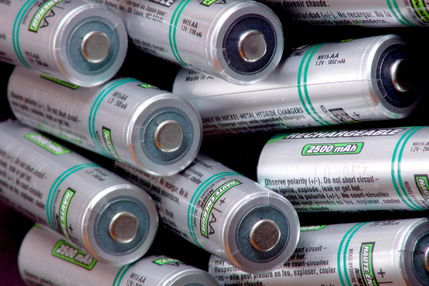
電池材料

粉
アプリケーションデータベースに各種資料を掲載しております。
粒子径分布測定装置 S3500 製品仕様
| Measuring range | 0.02 µm - 2.8 mm |
|---|---|
| Measuring principle | Laser diffraction |
| Lasers | 3x Red 780 nm |
| Laser power | 3 mW nominal |
| Detection system | Two fixed photo-electric detectors with logarithmically spaced segments placed at correct angles for optimal scattered light detection from 0.02 to 165 degrees using 151 detector segments. |
| Data | Volume, number and area distributions as well as percentile and other summary data |
| Data format | Stored in ODBC format in encrypted Microsoft Access Databases to ensure compatibility with external statistical software applications. |
| Data integrity | Data integrity may be ensured using FDA 21 CFR Part 11 compliant security features including password protection, electronic signatures and assignable permissions |
| Measuring time | ~ 10 to 30 seconds |
| Power requirements | AC input: 90 - 132 VAC, 47 - 63 Hz, single phase 200 to 265 VAC, 47 - 63 Hz, single phase |
| Power consumption | 25 W nominal, 50 W max. (depending on options installed) |
| Environmental conditions | Temperature: 5° to 40° Celsius (50° to 95° Fahrenheit) Humidity: 90% RH, non- condensing maximum Storage temperature: -10° to 50° Celsius (14° to 122° Fahrenheit) (dry only) Pollution: Degree 2 |
| Physical specifications | Case Material: Steel and impact resistant plastic Exterior surfaces are finished with corrosion resistant paint or plating |
| Dimensions (W x H x D) | ~ 560 x 360 x 460 mm (22 x 14 x 18 in) |
| Weight | ~ 27 kg (60 lbs ) |
| Eductor air supply | 100 psi (689 kPa) maximum pressure 5 CFM (8,5 m3/h) at 50 psi (345 kPa) minimum flow rate Free of dry contaminants, moisture and oil |
| Vacuum | Vacuum must exceed 50 CFM |
粒子径分布測定装置 S3500 資料ダウンロード
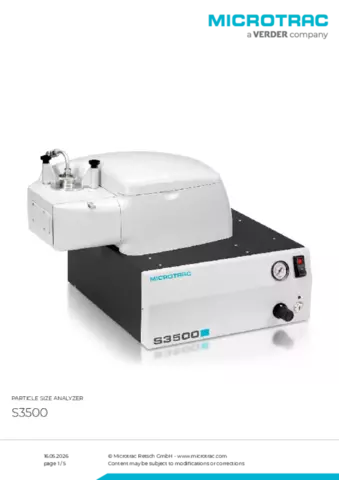
Product data sheet S3500
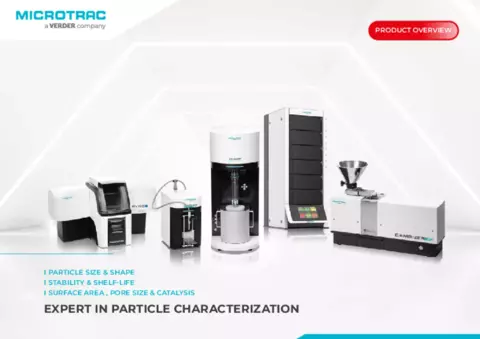
Product Overview

10 Most Common Errors in Particle Analysis - And How to Avoid Them
Particle analysis is an integral part of the quality control of bulk materials and is routinely performed in numerous laboratories. The methods used have often been established for years and are hardly ever questioned. Nevertheless, the procedure should be critically reviewed from time to time because a whole series of sources of error can negatively influence the results of a particle analysis. This white paper is intended to provide food for thought to make methods for particle characterization more reliable and accurate.

21 CFR Part 11 Compliance Matrix for Microtrac Instruments
This document explains how Microtrac FLEX software has been designed to satisfy and comply with regulations in 21 CFR Part 11 for electronic records and electronic signatures.
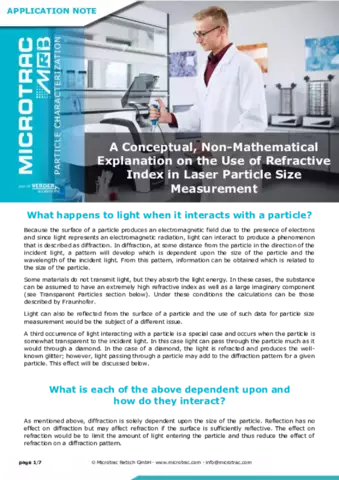
A Conceptual, Non-Mathematical Explanation on the Use of Refractive Index in Laser Particle Size Measurement
An explanation of Mie scattering and how Microtrac laser diffraction analyzers evaluate scattering signal from small particles.
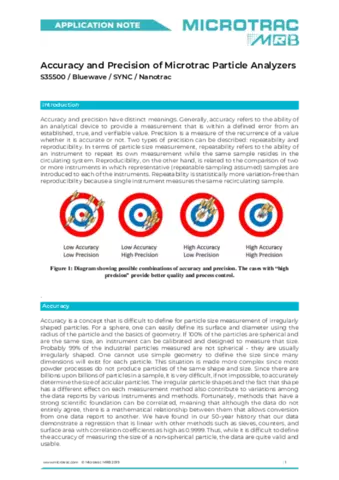
Accuracy and Precision of Microtrac Particle Analyzers
Accuracy and precision have distinct meanings. Generally, accuracy refers to the ability of an analytical device to provide a measurement that is within a defined error from an established, true, and verifiable value. Precision is a measure of the recurrence of a value whether it is accurate or not. Two types of precision can be described: repeatability and reproducibility. In terms of particle size measurement, repeatability refers to the ability of an instrument to repeat its own measurement while the same sample resides in the circulating system. Reproducibility, on the other hand, is related to the comparison of two or more instruments in which representative (repeatable sampling assumed) samples are introduced to each of the instruments. Repeatability is statistically more variation-free than reproducibility because a single instrument measures the same recirculating sample.