



Microtrac BLUEWAVE poskytuje přesnou, spolehlivou a opakovatelnou analýzu velikosti částic pro různé oblasti aplikací využitím osvědčené teorie kompenzace Mie pro sférické částice a proprietárního principu výpočtů Modified Mie pro nesférické částice.
BLUEWAVE je optimalizován pro materiály pod 1 mikronem a poskytuje nepřekonatelné rozlišení. BLUEWAVE měří velikost částic od 0.01 do 2800 mikronů.
Microtrac má tradici v poskytování inovativních řešení v analýze velikosti částic pomocí technologie rozptylu světla. Laserový difrakční analyzátor BLUEWAVE je pokračováním této tradice. Díky patentované technologii tří laserů poskytuje BLUEWAVE přesné, spolehlivé a opakovatelné informace o velikosti částic pro aplikace od výzkumu a vývoje po výrobu, proces a kontrolu kvality. BLUEWAVE vyhovuje nebo překračuje analýzu velikosti částic ISO 13320-1 - metody difrakce světla.
Vlastnosti
- Tří laserový, modrý/červený, vícedetektorový, víceúhlý optický systém
- Skutečně modré lasery (nikoli LED)
- Algoritmy, které využívají Mieho kompenzace a modifikované Mie výpočty pro sférické a nesférické materiály
- Možnost měření od 0.01 do 2800 mikronů
- Mokré a suché měření
- Uzavřená optická cesta zajišťuje úplnou ochranu optických součástí, což vede k malému nebo žádnému zásahu obsluhy
Výhody produktu
- S využitím modrých laserů se rozlišení nízko-koncových měření zvyšuje, aby se dramaticky zlepšila přesnost měření pod jeden mikron
- Výpočty proprietárního modifikovaného Mie umožňují uživatelům přesně měřit nesférické částice, které ostatní analyzátory částic snaží přesně charakterizovat
- Hladký přechod z mokrého na suché měření snižuje prostoje
- Fixní detektory poskytují silnou odolnost a zajišťují správné umístění
- Malý stolní model zabírá minimum pracovní plochy
Typické aplikace
Používá se v různých oblastech, jako je: nápoje, biotechnologie, chemikálie, potrava, geologie / těžba, medicína / farmaceutika, kovové prášky, kovy, pigmenty, polymery, práškové nátěry, ...

chemikálie
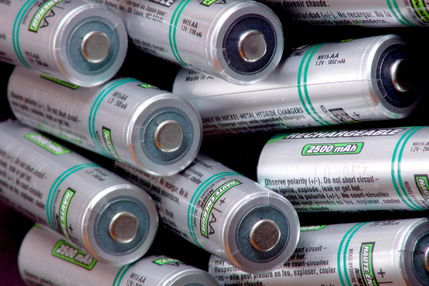
bateriový materiál
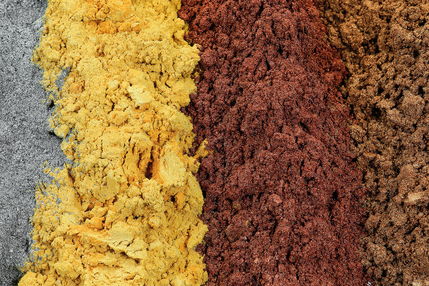
prášky
Chcete-li najít nejlepší řešení pro vaše potřeby charakterizace částic, navštivte naši aplikační databázi
Analyzátor velikosti částic BLUEWAVE Technické údaje
| Measuring range | 0.01 µm - 2.8 mm |
|---|---|
| Measuring principle | Laser diffraction |
| Lasers | 1x Red 780 nm / 2x Blue 405 nm |
| Laser power | Red laser 3 mW nominal Blue lasers 4 - 8 mW nominal |
| Detection system | Two fixed photo-electric detectors with logarithmically spaced segments placed at correct angles for optimal scattered light detection from 0.02 to 165 degrees using 151 detector segments. |
| Data | Volume, number and area distributions as well as percentile and other summary data |
| Data format | Stored in ODBC format in encrypted Microsoft Access Databases to ensure compatibility with external statistical software applications. |
| Data integrity | Data integrity may be ensured using FDA 21 CFR Part 11 compliant security features including password protection, electronic signatures and assignable permissions |
| Measuring time | ~ 10 to 30 seconds |
| Power requirements | AC input: 90 - 132 VAC, 47 - 63 Hz, single phase 200 to 265 VAC, 47 - 63 Hz, single phase |
| Power consumption | 25 W nominal, 50 W max. (depending on options installed) |
| Environmental conditions | Temperature: 5° to 40° Celsius (50° to 95° Fahrenheit) Humidity: 90% RH, non- condensing maximum Storage temperature: -10° to 50° Celsius (14° to 122° Fahrenheit) (dry only) Pollution: Degree 2 |
| Physical specifications | Case Material: Steel and impact resistant plastic Exterior surfaces are finished with corrosion resistant paint or plating |
| Dimensions (W x H x D) | ~ 560 x 360 x 460 mm (22 x 14 x 18 in) |
| Weight | ~ 27 kg (60 lbs ) |
| Eductor air supply | 100 psi (689 kPa) maximum pressure 5 CFM (8,5 m3/h) at 50 psi (345 kPa) minimum flow rate Free of dry contaminants, moisture and oil |
| Vacuum | Vacuum must exceed 50 CFM |
Analyzátor velikosti částic BLUEWAVE Ke stažení
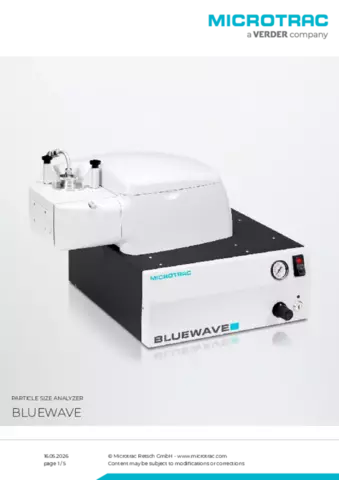
Product data sheet Bluewave
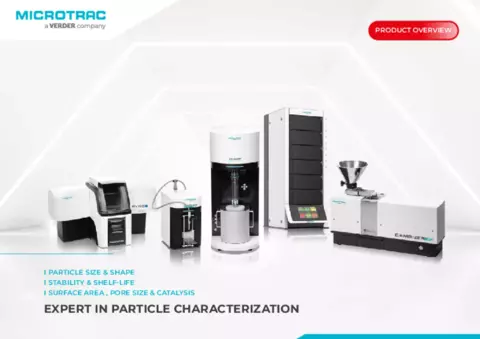
Product Overview

10 Most Common Errors in Particle Analysis - And How to Avoid Them
Particle analysis is an integral part of the quality control of bulk materials and is routinely performed in numerous laboratories. The methods used have often been established for years and are hardly ever questioned. Nevertheless, the procedure should be critically reviewed from time to time because a whole series of sources of error can negatively influence the results of a particle analysis. This white paper is intended to provide food for thought to make methods for particle characterization more reliable and accurate.

21 CFR Part 11 Compliance Matrix for Microtrac Instruments
This document explains how Microtrac FLEX software has been designed to satisfy and comply with regulations in 21 CFR Part 11 for electronic records and electronic signatures.
A Conceptual, Non-Mathematical Explanation on the Use of Refractive Index in Laser Particle Size Measurement
An explanation of Mie scattering and how Microtrac laser diffraction analyzers evaluate scattering signal from small particles.
Accuracy and Precision of Microtrac Particle Analyzers
Accuracy and precision have distinct meanings. Generally, accuracy refers to the ability of an analytical device to provide a measurement that is within a defined error from an established, true, and verifiable value. Precision is a measure of the recurrence of a value whether it is accurate or not. Two types of precision can be described: repeatability and reproducibility. In terms of particle size measurement, repeatability refers to the ability of an instrument to repeat its own measurement while the same sample resides in the circulating system. Reproducibility, on the other hand, is related to the comparison of two or more instruments in which representative (repeatable sampling assumed) samples are introduced to each of the instruments. Repeatability is statistically more variation-free than reproducibility because a single instrument measures the same recirculating sample.