



BLUEWAVE di Microtrac fornisce un'analisi della dimensione delle particelle accurata, affidabile e ripetibile per una vasta gamma di applicazioni utilizzando la comprovata teoria di compensazione Mie ed il proprio algoritmo di calcolo modificato per particelle non sferiche.
BLUEWAVE è stato ottimizzato per materiali inferiori a 1 micron, offrendo una risoluzione insuperabile. BLUEWAVE misura la dimensione delle particelle da 0,01 a 2.800 µm.
Microtrac ha una tradizione nella fornitura di soluzioni innovative nell'analisi delle dimensioni delle particelle attraverso la tecnologia di diffusione della luce. L'analizzatore a diffrazione laser BLUEWAVE è una conferma di quella tradizione. Utilizzando la tecnologia tri-laser brevettata, BLUEWAVE fornisce informazioni sulla dimensione delle particelle accurate, affidabili e ripetibili per applicazioni che vanno dalla ricerca e sviluppo alla produzione, al processo e controllo di qualità. BLUEWAVE è conforme o supera i metodi per la diffrazione della luce normati dalla ISO 13320-1
Caratteristiche
- Tre-laser, blu/ rosso, multi-detector, sistema ottico multi angolo
- Veri laser Blu (non LEDs)
- Algoritmi che utilizzano la compensazione Mie e i calcoli Mie modificati per particelle non sferiche
- Range di misura da 0.01 a 2,800 µm
- Granulometria a secco ed umido
- Il percorso protetto chiuso garantisce una protezione completa dei componenti ottici con un intervento minimo o nullo da parte dell'operatore
Vantaggi prodotto
- Utilizzando i laser blu, la risoluzione delle misurazioni di fascia bassa viene incrementata per migliorare notevolmente la precisione delle misurazioni al di sotto di un micron
- I calcoli di Mie modificati e brevettati consentono di misurare con precisione le particelle non sferiche che altri analizzatori laser faticano a caratterizzare con precisione.
- La transizione senza interruzioni dalla misurazione a umido a quella a secco riduce i tempi morti
- I rilevatori fissi offrono robustezza e durata assicurando il corretto posizionamento
- Ingombro ridotto
Applicazioni tipiche
Utilizzati in innumerevoli applicazioni come: bevande, biotecnologie, chimici, cibo, Geologico / Minerario, medicine/farmaci, polveri metalliche, metalli, pigmenti, polimeri, vernici in polvere, ...

chimici
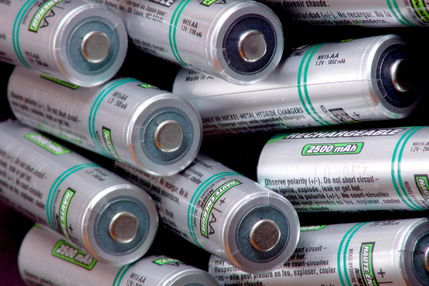
materiali per batterie
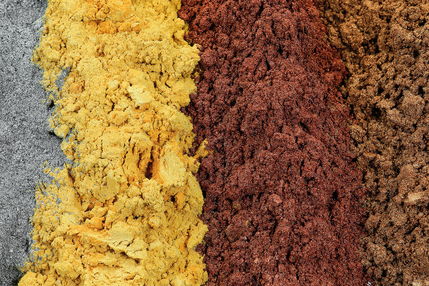
polveri
Per trovare la soluzione migliore per le vostre esigenze sulla caratterizzazione granulometrica, visitate il nostro database applicativo
Analizzatore delle dimensioni delle particelle BLUEWAVE Dati tecnici
| Measuring range | 0.01 µm - 2.8 mm |
|---|---|
| Measuring principle | Laser diffraction |
| Lasers | 1x Red 780 nm / 2x Blue 405 nm |
| Laser power | Red laser 3 mW nominal Blue lasers 4 - 8 mW nominal |
| Detection system | Two fixed photo-electric detectors with logarithmically spaced segments placed at correct angles for optimal scattered light detection from 0.02 to 165 degrees using 151 detector segments. |
| Data | Volume, number and area distributions as well as percentile and other summary data |
| Data format | Stored in ODBC format in encrypted Microsoft Access Databases to ensure compatibility with external statistical software applications. |
| Data integrity | Data integrity may be ensured using FDA 21 CFR Part 11 compliant security features including password protection, electronic signatures and assignable permissions |
| Measuring time | ~ 10 to 30 seconds |
| Power requirements | AC input: 90 - 132 VAC, 47 - 63 Hz, single phase 200 to 265 VAC, 47 - 63 Hz, single phase |
| Power consumption | 25 W nominal, 50 W max. (depending on options installed) |
| Environmental conditions | Temperature: 5° to 40° Celsius (50° to 95° Fahrenheit) Humidity: 90% RH, non- condensing maximum Storage temperature: -10° to 50° Celsius (14° to 122° Fahrenheit) (dry only) Pollution: Degree 2 |
| Physical specifications | Case Material: Steel and impact resistant plastic Exterior surfaces are finished with corrosion resistant paint or plating |
| Dimensions (W x H x D) | ~ 560 x 360 x 460 mm (22 x 14 x 18 in) |
| Weight | ~ 27 kg (60 lbs ) |
| Eductor air supply | 100 psi (689 kPa) maximum pressure 5 CFM (8,5 m3/h) at 50 psi (345 kPa) minimum flow rate Free of dry contaminants, moisture and oil |
| Vacuum | Vacuum must exceed 50 CFM |
Analizzatore delle dimensioni delle particelle BLUEWAVE Scarica
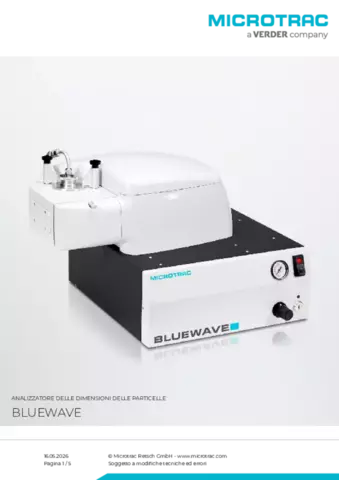
Scheda tecnica del prodotto Bluewave
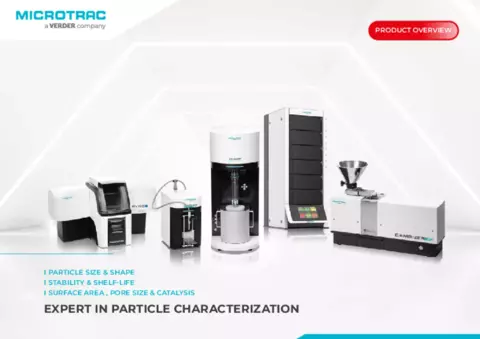
Product Overview

10 Most Common Errors in Particle Analysis - And How to Avoid Them
Particle analysis is an integral part of the quality control of bulk materials and is routinely performed in numerous laboratories. The methods used have often been established for years and are hardly ever questioned. Nevertheless, the procedure should be critically reviewed from time to time because a whole series of sources of error can negatively influence the results of a particle analysis. This white paper is intended to provide food for thought to make methods for particle characterization more reliable and accurate.

21 CFR Part 11 Compliance Matrix for Microtrac Instruments
This document explains how Microtrac FLEX software has been designed to satisfy and comply with regulations in 21 CFR Part 11 for electronic records and electronic signatures.
A Conceptual, Non-Mathematical Explanation on the Use of Refractive Index in Laser Particle Size Measurement
An explanation of Mie scattering and how Microtrac laser diffraction analyzers evaluate scattering signal from small particles.
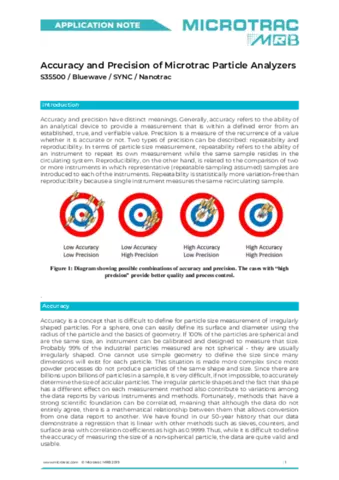
Accuracy and Precision of Microtrac Particle Analyzers
Accuracy and precision have distinct meanings. Generally, accuracy refers to the ability of an analytical device to provide a measurement that is within a defined error from an established, true, and verifiable value. Precision is a measure of the recurrence of a value whether it is accurate or not. Two types of precision can be described: repeatability and reproducibility. In terms of particle size measurement, repeatability refers to the ability of an instrument to repeat its own measurement while the same sample resides in the circulating system. Reproducibility, on the other hand, is related to the comparison of two or more instruments in which representative (repeatable sampling assumed) samples are introduced to each of the instruments. Repeatability is statistically more variation-free than reproducibility because a single instrument measures the same recirculating sample.