



BLUEWAVE firmy Microtrac zapewnia dokładną, niezawodną i powtarzalną analizę wielkości cząstek w różnorodnych zastosowaniach, wykorzystując sprawdzoną teorię Mie dla cząstek sferycznych oraz zastrzeżoną zasadę zmodyfikowanych obliczeń Mie dla cząstek niesferycznych. BLUEWAVE jest zoptymalizowany po kątem materiałów o wielkości mniejszej niż 1 mikrometr, zapewniając niezrównaną rozdzielczość. BLUEWAVE mierzy cząstki w zakresie pomiarowym od 0,01 do 2 800 µm. Microtrac ma ogromne doświadczenie w dostarczaniu innowacyjnych rozwiązań do analizy wielkości cząstek metodą rozpraszania światła. Analizator dyfrakcji laserowej (LD) BLUEWAVE jest kontynuacją tej tradycji. Wykorzystując opatentowaną technologię trzech laserów, BLUEWAVE dostarcza dokładnych, wiarygodnych i powtarzalnych informacji o wielkości cząstek w zastosowaniach od badań i rozwoju do produkcji, procesu i kontroli jakości. BLUEWAVE nie tylko spełnia, ale wręcz przekracza wymagania normy ISO 13320-1 w zakresie analizy wielkości cząstek metodą dyfrakcji światła.
Cechy
- Tri-laser, niebieski / czerwony, wielodetektorowy, wielokątowy układ optyczny
- Prawdziwe niebieskie lasery (nie diody LED)
- Algorytmy wykorzystujące kompensację Mie i zmodyfikowane obliczenia Mie dla materiałów sferycznych i niekulistych
- Możliwość pomiaru od 0,01 do 2800 µm
- Pomiar na mokro i sucho
- Zamknięta ścieżka optyczna zapewnia pełną ochronę elementów optycznych, wymagająca niewielkiej lub żadnej interwencji operatora
Zalety produktu
- Wykorzystuje niebieskie lasery, rozdzielczość pomiarów w dolnym obszarze zakresu pomiarowego znacznie wzrasta - mocno zwiększona dokładność pomiarów cząstek poniżej jednego mikrona.
- Opatentowana modyfikacja kompensacji Mie pozwala użytkownikom na dokładny pomiar cząstek niesferycznych, których inne analizatory cząstek nie są w stanie dokładnie scharakteryzować.
- Płynne przejście z pomiarów na mokro do pomiarów na sucho zmniejsza czas przestojów
- Nieruchome detektory zapewniają solidność, trwałość oraz gwarancję prawidłowego położenia w każdym pomiarze
- Niewielkie wymiary pozwalające na efektywne wykorzystanie cennej przestrzeni laboratoryjnej
Typowe aplikacje
Używany w różnych dziedzinach, takich jak: napoje, biotechnologia, chemikalia, żywność, geologia/górnictwo, medycyna/farmacja, proszki metali, metale, pigmenty, polimery, powłoki proszkowe, ...

chemikalia
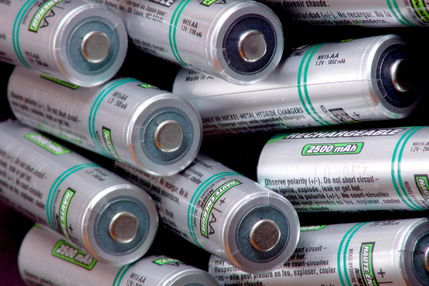
materiały baterii
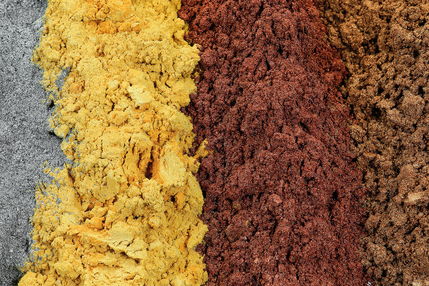
proszki
Aby znaleźć najlepsze rozwiązanie dla swoich potrzeb w zakresie charakterystyki cząstek, odwiedź naszą bazę danych aplikacji
Analizator wielkości cząstek BLUEWAVE Dane techniczne
| Measuring range | 0.01 µm - 2.8 mm |
|---|---|
| Measuring principle | Laser diffraction |
| Lasers | 1x Red 780 nm / 2x Blue 405 nm |
| Laser power | Red laser 3 mW nominal Blue lasers 4 - 8 mW nominal |
| Detection system | Two fixed photo-electric detectors with logarithmically spaced segments placed at correct angles for optimal scattered light detection from 0.02 to 165 degrees using 151 detector segments. |
| Data | Volume, number and area distributions as well as percentile and other summary data |
| Data format | Stored in ODBC format in encrypted Microsoft Access Databases to ensure compatibility with external statistical software applications. |
| Data integrity | Data integrity may be ensured using FDA 21 CFR Part 11 compliant security features including password protection, electronic signatures and assignable permissions |
| Measuring time | ~ 10 to 30 seconds |
| Power requirements | AC input: 90 - 132 VAC, 47 - 63 Hz, single phase 200 to 265 VAC, 47 - 63 Hz, single phase |
| Power consumption | 25 W nominal, 50 W max. (depending on options installed) |
| Environmental conditions | Temperature: 5° to 40° Celsius (50° to 95° Fahrenheit) Humidity: 90% RH, non- condensing maximum Storage temperature: -10° to 50° Celsius (14° to 122° Fahrenheit) (dry only) Pollution: Degree 2 |
| Physical specifications | Case Material: Steel and impact resistant plastic Exterior surfaces are finished with corrosion resistant paint or plating |
| Dimensions (W x H x D) | ~ 560 x 360 x 460 mm (22 x 14 x 18 in) |
| Weight | ~ 27 kg (60 lbs ) |
| Eductor air supply | 100 psi (689 kPa) maximum pressure 5 CFM (8,5 m3/h) at 50 psi (345 kPa) minimum flow rate Free of dry contaminants, moisture and oil |
| Vacuum | Vacuum must exceed 50 CFM |
Analizator wielkości cząstek BLUEWAVE Do pobrania
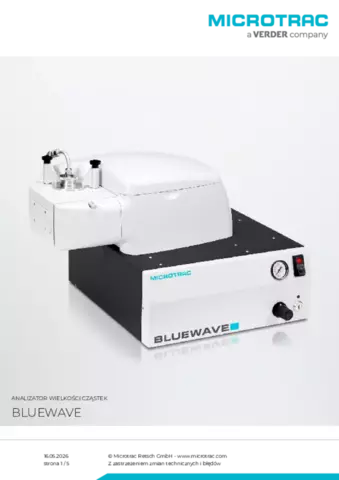
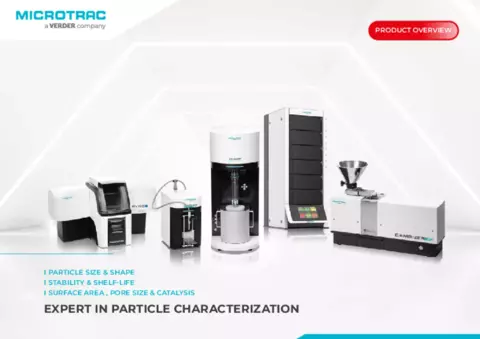
Product Overview

10 Most Common Errors in Particle Analysis - And How to Avoid Them
Particle analysis is an integral part of the quality control of bulk materials and is routinely performed in numerous laboratories. The methods used have often been established for years and are hardly ever questioned. Nevertheless, the procedure should be critically reviewed from time to time because a whole series of sources of error can negatively influence the results of a particle analysis. This white paper is intended to provide food for thought to make methods for particle characterization more reliable and accurate.

21 CFR Part 11 Compliance Matrix for Microtrac Instruments
This document explains how Microtrac FLEX software has been designed to satisfy and comply with regulations in 21 CFR Part 11 for electronic records and electronic signatures.
A Conceptual, Non-Mathematical Explanation on the Use of Refractive Index in Laser Particle Size Measurement
An explanation of Mie scattering and how Microtrac laser diffraction analyzers evaluate scattering signal from small particles.
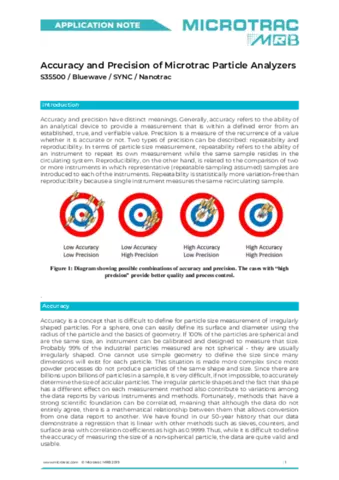
Accuracy and Precision of Microtrac Particle Analyzers
Accuracy and precision have distinct meanings. Generally, accuracy refers to the ability of an analytical device to provide a measurement that is within a defined error from an established, true, and verifiable value. Precision is a measure of the recurrence of a value whether it is accurate or not. Two types of precision can be described: repeatability and reproducibility. In terms of particle size measurement, repeatability refers to the ability of an instrument to repeat its own measurement while the same sample resides in the circulating system. Reproducibility, on the other hand, is related to the comparison of two or more instruments in which representative (repeatable sampling assumed) samples are introduced to each of the instruments. Repeatability is statistically more variation-free than reproducibility because a single instrument measures the same recirculating sample.