



De BLUEWAVE van Microtrac biedt accurate, betrouwbare en reproduceerbare deeltjesgrootte analyse voor diverse toepassingsgebieden door gebruik te maken van de beproefde theorie van Mie compensatie voor sferische deeltjes en de eigen ontwikkelde principes over gemodificeerde Mie berekeningen voor niet-sferische deeltjes.
De BLUEWAVE is geoptimaliseerd voor materialen onder 1 micron, met een ongezien nauwkeurige resolutie. Het BLUEWAVE appataat meet deeltjesgroottes van 0.01 tot 2800 µm.
Microtrac heeft een traditie om innovatoeve oplossingen in deeltjesgrootte-analyse uit te werken met behulp van licht verstrooiing technologie. De BLUEWAVE laser diffractie analyser is een vervolg op die traditie. Met de gepatenteerde tri-laser technologie biedt de BLUEWAVE accurate, betrouwbare en reproduceerbare deeltjesgrootte informatie voor toepassingen van onderzoek & ontwikkeling tot productie-, proces- en kwaliteitscontrole. De BLUEWAVE komt overeen of overtreft de ISO 13320-1 deeltjesgrootte analyse – licht diffractie methodes.
Kenmerken
- Tri–laser, blauw / rood, multi-detector, multi-hoeks optisch systeem
- Echte blauwe lasers (geen LEDs)
- Algorithmes die gebruik maken van Mie compensatie en Gemodificeerde Mie berekeningen voor sferische en niet-sferische materialen
- Meetbereik van 0.01 tot 2800 µm
- Natte en droge metingen
- Het ingesloten optische pad waarborgt volledige bescherming van de optische componenten, met weinig tot geen tussenkomst door de gebruiker tot gevolg
Productvoordelen
- Met behulp van blauwe lasers verbetert de resolutie aan de ondergrens waardoor de nauwkeurigheid on het submicron bereik drastisch verbetert
- De zelf verbeterde Mie berekeningen laten gebruikers toe om accuraat niet-sferische deeltjes te meten, waarmee andere analysetoestellen problemen ondervinden
- Naadloze overgang van natte naar droge meting vermindert de wachttijden
- Vaste detectoren garanderen een robuuste, duurzame en betrouwbare positionering
- Kleine tafelruimte biedt mogelijkheden met waardevolle laboratoriumplaats
Typische Toepassingen
Gebruikt in verschillende domeinen, zoals: dranken, biotechnologie, chemicaliën, voedsel, geologie / mijnbouw, geneesmiddel / medicijnen, metaalpoeders, metalen, pigmenten, polymeren, poederbekledingen, ...

chemicaliën
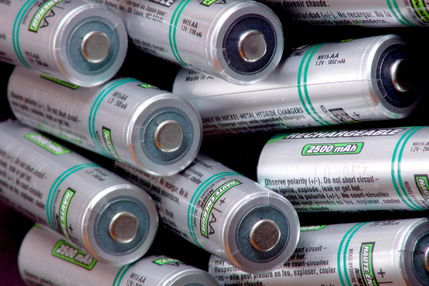
batterij materialen
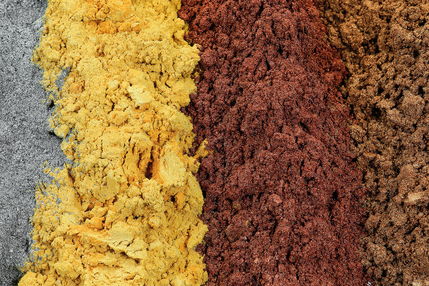
poeders
Om de beste oplossing te vinden voor uw deeltjes-karakterisatie behoeften, kunt u onze toepassingsdatabase consulteren
Deeltjes Grootte Analyse BLUEWAVE Technische Gegevens
| Measuring range | 0.01 µm - 2.8 mm |
|---|---|
| Measuring principle | Laser diffraction |
| Lasers | 1x Red 780 nm / 2x Blue 405 nm |
| Laser power | Red laser 3 mW nominal Blue lasers 4 - 8 mW nominal |
| Detection system | Two fixed photo-electric detectors with logarithmically spaced segments placed at correct angles for optimal scattered light detection from 0.02 to 165 degrees using 151 detector segments. |
| Data | Volume, number and area distributions as well as percentile and other summary data |
| Data format | Stored in ODBC format in encrypted Microsoft Access Databases to ensure compatibility with external statistical software applications. |
| Data integrity | Data integrity may be ensured using FDA 21 CFR Part 11 compliant security features including password protection, electronic signatures and assignable permissions |
| Measuring time | ~ 10 to 30 seconds |
| Power requirements | AC input: 90 - 132 VAC, 47 - 63 Hz, single phase 200 to 265 VAC, 47 - 63 Hz, single phase |
| Power consumption | 25 W nominal, 50 W max. (depending on options installed) |
| Environmental conditions | Temperature: 5° to 40° Celsius (50° to 95° Fahrenheit) Humidity: 90% RH, non- condensing maximum Storage temperature: -10° to 50° Celsius (14° to 122° Fahrenheit) (dry only) Pollution: Degree 2 |
| Physical specifications | Case Material: Steel and impact resistant plastic Exterior surfaces are finished with corrosion resistant paint or plating |
| Dimensions (W x H x D) | ~ 560 x 360 x 460 mm (22 x 14 x 18 in) |
| Weight | ~ 27 kg (60 lbs ) |
| Eductor air supply | 100 psi (689 kPa) maximum pressure 5 CFM (8,5 m3/h) at 50 psi (345 kPa) minimum flow rate Free of dry contaminants, moisture and oil |
| Vacuum | Vacuum must exceed 50 CFM |
Deeltjes Grootte Analyse BLUEWAVE Downloads
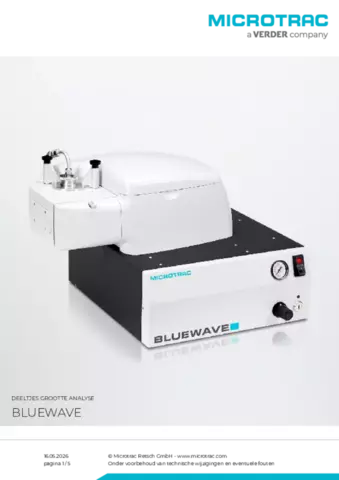
Productinformatieblad Bluewave
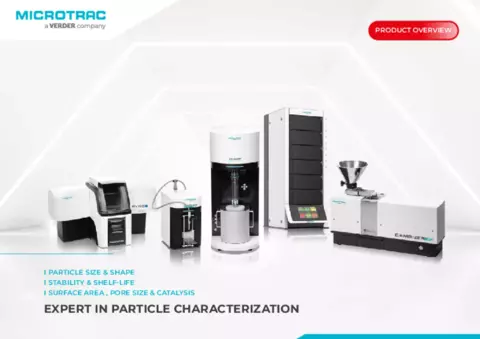
Product Overview

10 Most Common Errors in Particle Analysis - And How to Avoid Them
Particle analysis is an integral part of the quality control of bulk materials and is routinely performed in numerous laboratories. The methods used have often been established for years and are hardly ever questioned. Nevertheless, the procedure should be critically reviewed from time to time because a whole series of sources of error can negatively influence the results of a particle analysis. This white paper is intended to provide food for thought to make methods for particle characterization more reliable and accurate.

21 CFR Part 11 Compliance Matrix for Microtrac Instruments
This document explains how Microtrac FLEX software has been designed to satisfy and comply with regulations in 21 CFR Part 11 for electronic records and electronic signatures.
A Conceptual, Non-Mathematical Explanation on the Use of Refractive Index in Laser Particle Size Measurement
An explanation of Mie scattering and how Microtrac laser diffraction analyzers evaluate scattering signal from small particles.
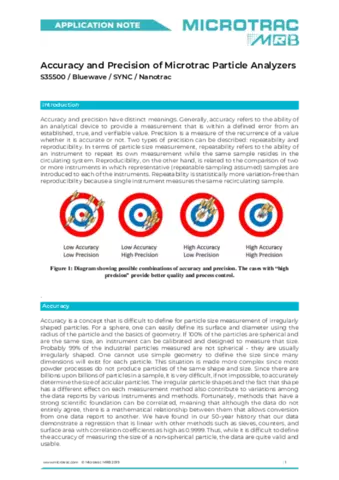
Accuracy and Precision of Microtrac Particle Analyzers
Accuracy and precision have distinct meanings. Generally, accuracy refers to the ability of an analytical device to provide a measurement that is within a defined error from an established, true, and verifiable value. Precision is a measure of the recurrence of a value whether it is accurate or not. Two types of precision can be described: repeatability and reproducibility. In terms of particle size measurement, repeatability refers to the ability of an instrument to repeat its own measurement while the same sample resides in the circulating system. Reproducibility, on the other hand, is related to the comparison of two or more instruments in which representative (repeatable sampling assumed) samples are introduced to each of the instruments. Repeatability is statistically more variation-free than reproducibility because a single instrument measures the same recirculating sample.