




Building materials are required for a wide range of construction work including carpentry, roofing, structural reinforcement, insulation, and plumbing. The particle size and particle shape of the raw materials influence quality and performance of the end product, and therefore require quality control by particle characterization. Microtrac analyzers are successfully used to determine the size and shape of various building materials.
Building materials range from naturally occurring substances such as rock, clay, sand, and wood to synthetic polymers and multiple combinations of both (composites). Concrete or mortar are for example mixtures of cement and aggregates like sand or gravel.
Why are particle properties so important for building materials?
- Powder flow: a wide distribution or too many fines reduce flowability
- Segregation: a wide distribution will lead to size segregation
- Suspension rheology: fines or irregularly shaped particles increase viscosity
Problematic effects due to oversized particles
- Poor quality of the final product (grains sticking out of the plaster, rough surfaces of tiles, inhomogeneous materials may break)
- Changes in the “look and feel” of the final product
- Changes in the flow behavior and other process parameters of the final product
- Blockage of production sieves
- Removal of material from the production process, and recycling (additional costs and effort)
Problematic effects due to undersized particles
- Change of the “look and feel” of the final product
- Dust (pollution) in the work place
- Filter blockage
- Changes in the flow behaviour and other process parameters of the final product
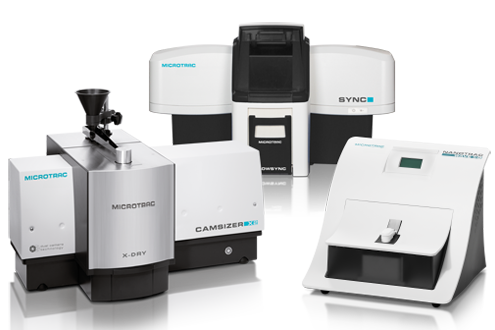
Microtrac提供满足各中颗粒分析技术的设备
解决方案 使用 Turbiscan 进行 SMLS 粒度分析
更短的測量時間。更優異的光學解析度。每秒更多幀數。
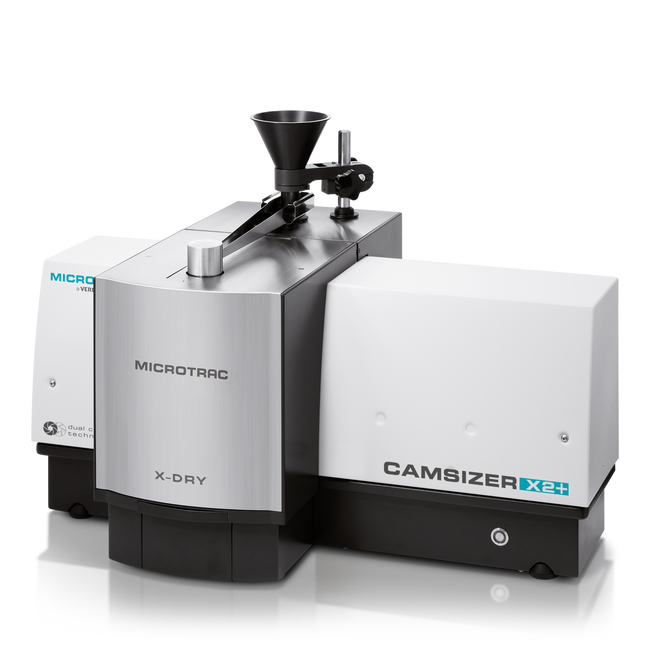
CAMSIZER X2+是一款功能强大、用途极其广泛的粒度粒形分析仪,其测量范围宽,结合了最先进的双CCD镜头技术和灵活的分散模块选项。基于动态图像分析原理(ISO 13322-2),CAMSIZER X2+可在1μm至8 mm的测量范围内提供粉末、颗粒和悬浮液的精确粒度粒形信息。
CAMSIZER X2+产生的颗粒流,通过具有高分辨率光学系统进行表征。一个超亮LED频闪光源和两个高分辨率数码相机,可以达到每秒420多张图像的帧速率,并通过强大的软件进行实时评估。因此,CAMSIZER X2+可以在1到3分钟内以最高的精确度捕捉数十万到数百万个颗粒的图像。
CAMSIZER X2+提供了广泛的颗粒信息选项,实现对样品材料进行全面和可靠的表征。它适用于研发和日常质量控制。
案例 1 Describing static light scattering patterns
In most cases the particle size distribution of sand used in building materials is analyzed by sieve analysis. Microtrac's CAMSIZER series can replace this time-consuming and error-prone technique with a quicker, more reliable method that provides a higher resolution of particle size results as well as additional particle shape information.
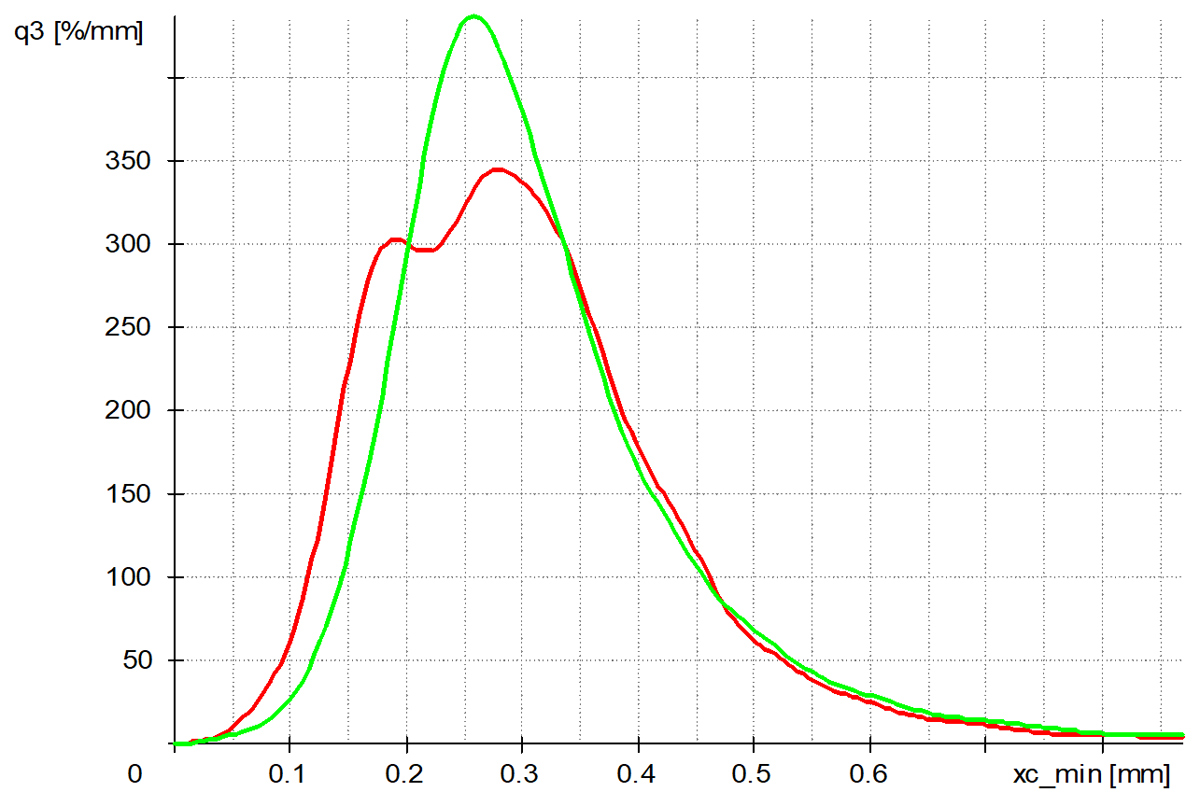
Two types of sand taken from different locations, measured with the CAMSIZER X2. This sand is used as a layer in glass-reinforced plastic pipes to increase the stiffness. The reported size parameter is xc min (=particle width). The red curve is slightly bimodal. Sand with a wide size distribution can be more closely packed in the core of the pipe which gives the finished product a higher stability.
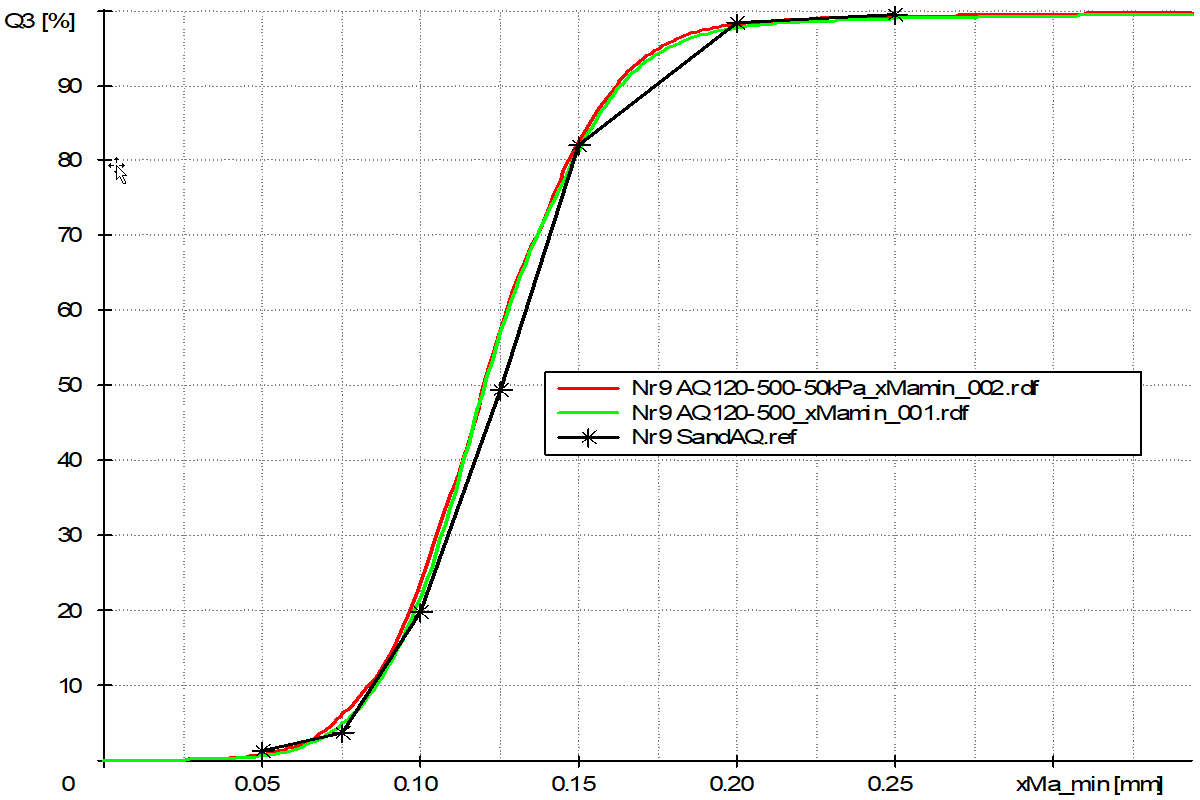
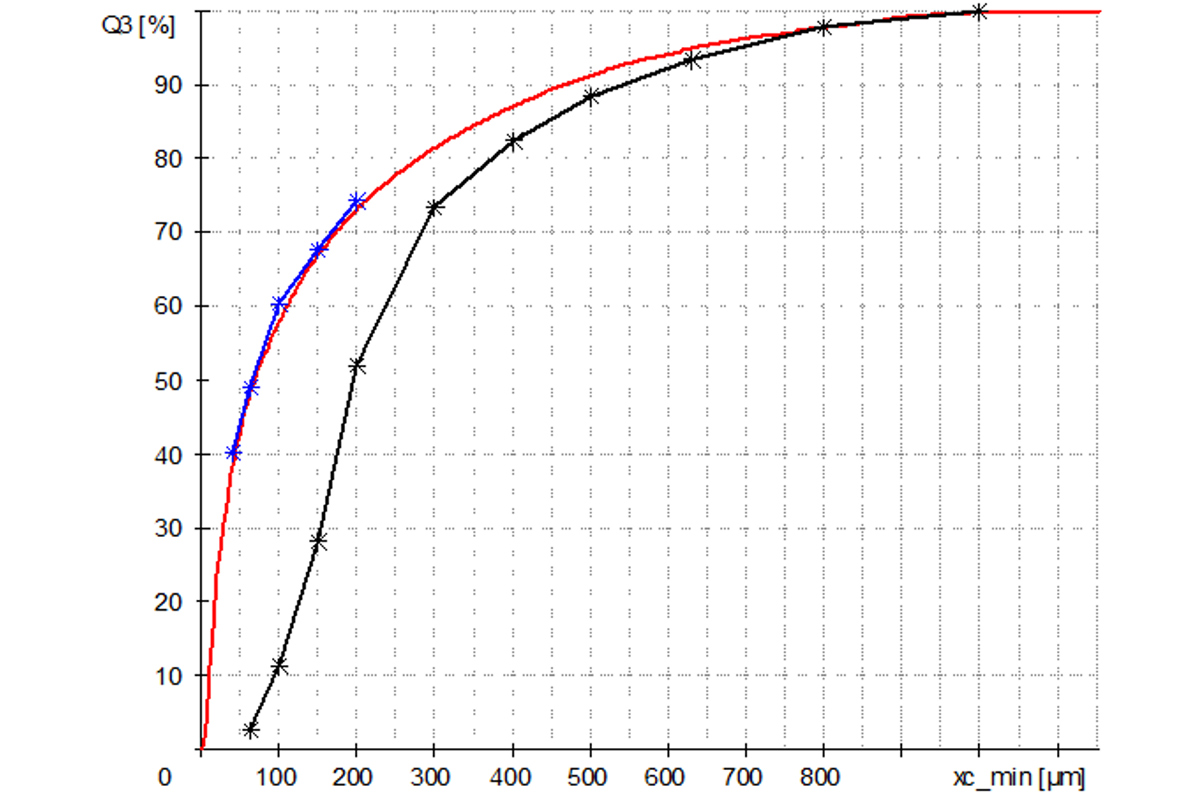
One sand sample that was measured by sieving (black) and by the CAMSIZER X2 using two different dispersion modules: the X-Fall module (green) and the X-Jet module (red). The results compare extremely well, proving that CAMSIZER X2 can match existing sieve analysis results. Hence, product specifications based on sieve analysis can remain unchanged when transitioning to a CAMSIZER system.
案例 2 Particle size & shape analysis of limestone
Limestone (calcium carbonate) is a raw material used in many products.
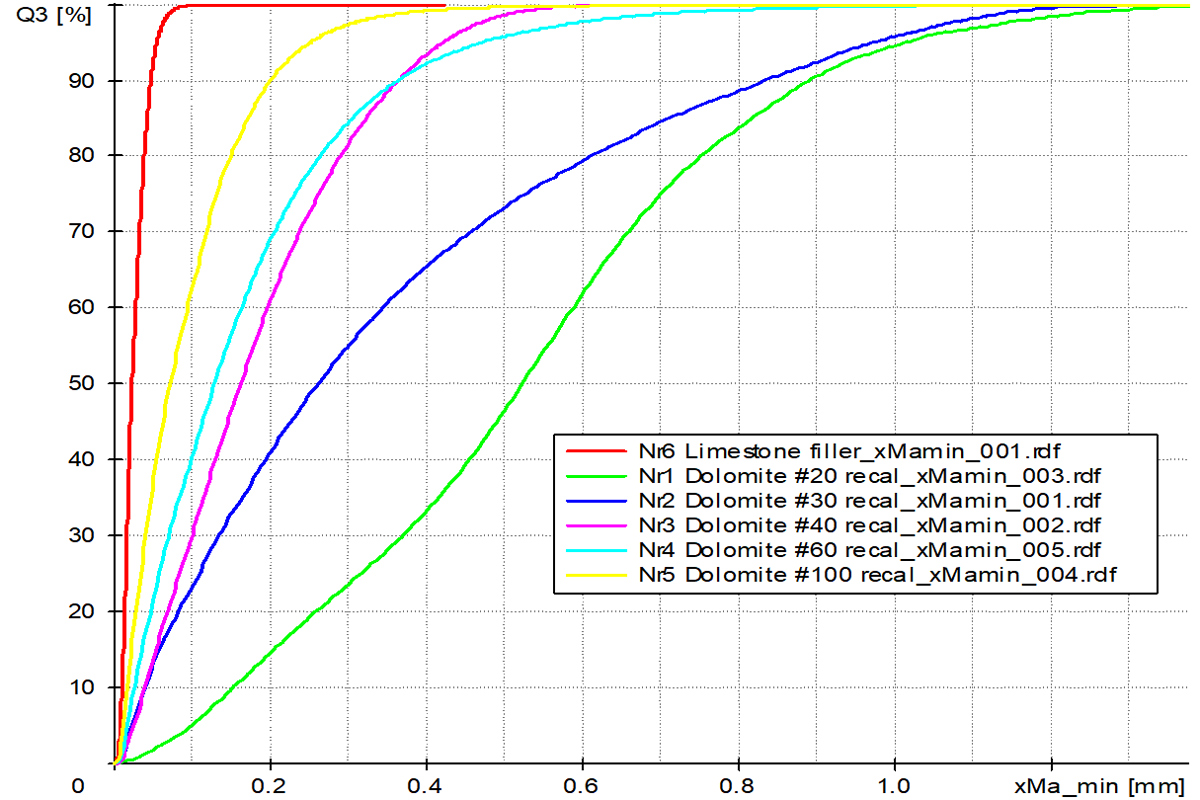
The particle size distribution as measured with the CAMSIZER X2 for a range of limestone grades.
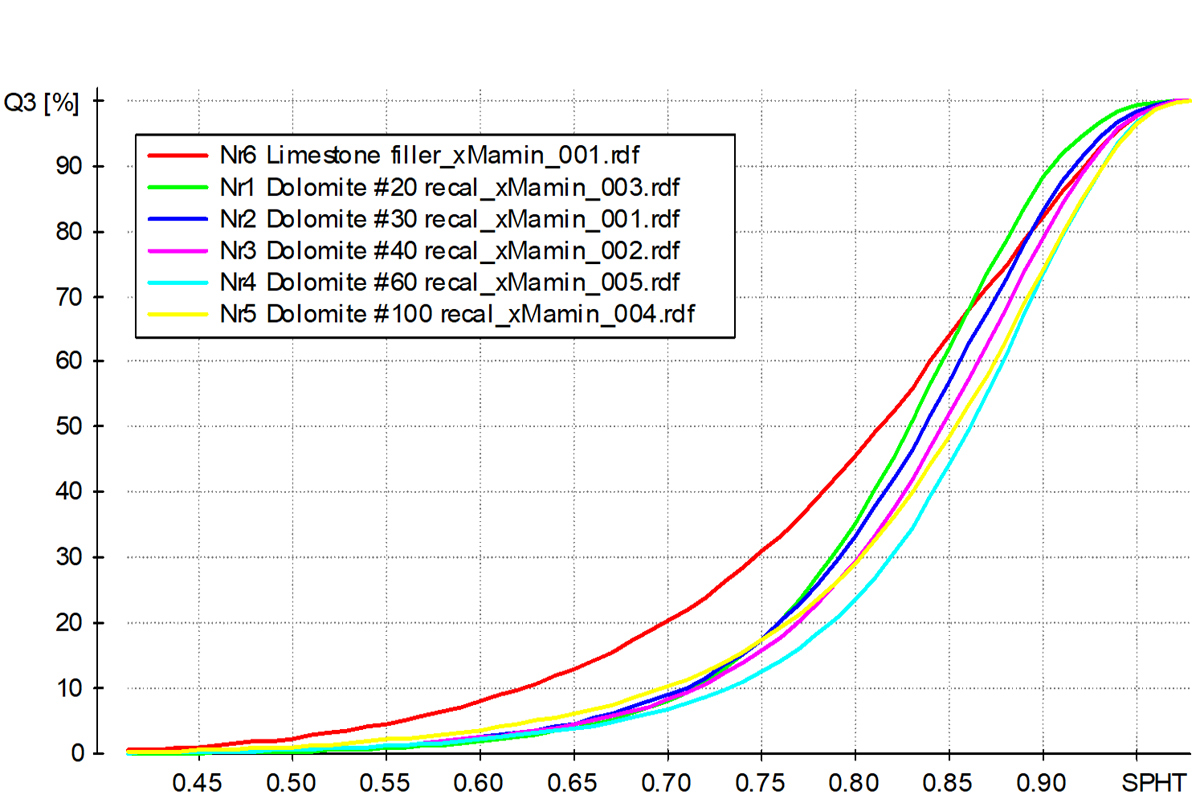
The particle shape distribution results for the same collection of limestone samples. The reported shape parameter is sphericity, defined as: sphericity = 4 p A/ P2 where "A = Area of the particle projection" and "P = Perimeter length of the particle projection". The least round sample is Nr 6 (red), while the most round sample is Nr 4 (light blue).
案例 3 Effective dispersion of plaster samples
The characteristic light scattering patterns which are formed when a laser interacts with particles are caused by diffraction, refraction, reflection, and absorption (as shown on the figure).
For large particles, diffraction, which occurs at the contour of particles, is the dominant mechanism. This is sufficiently described by the so-called Fraunhofer theory. "Large particles" in this context means "significantly larger than the wavelength of light".
For the description and evaluation of scattered light patterns of smaller particles, the optical properties, essentially the refractive index, must be considered. This is described by the Mie theory, which, however, also includes diffraction and therefore allows a comprehensive evaluation of light scattering phenomena.
Literature values are available for the refractive indices of almost all solids, so Mie theory can be applied very reliably for static light scattering. Static light scattering is often referred to as laser diffraction or laser diffractometry, even independent of the size of the particles considered and the phenomena that occur.
案例 4 Detection of oversize in tile coatings
Save and reliable detection of oversized particles are among the most important objectives of particle size analyis. For this purpose, Dynamic Image Analysis with the CAMSIZER X2 is the most powerful technique with unmatched accuracy.
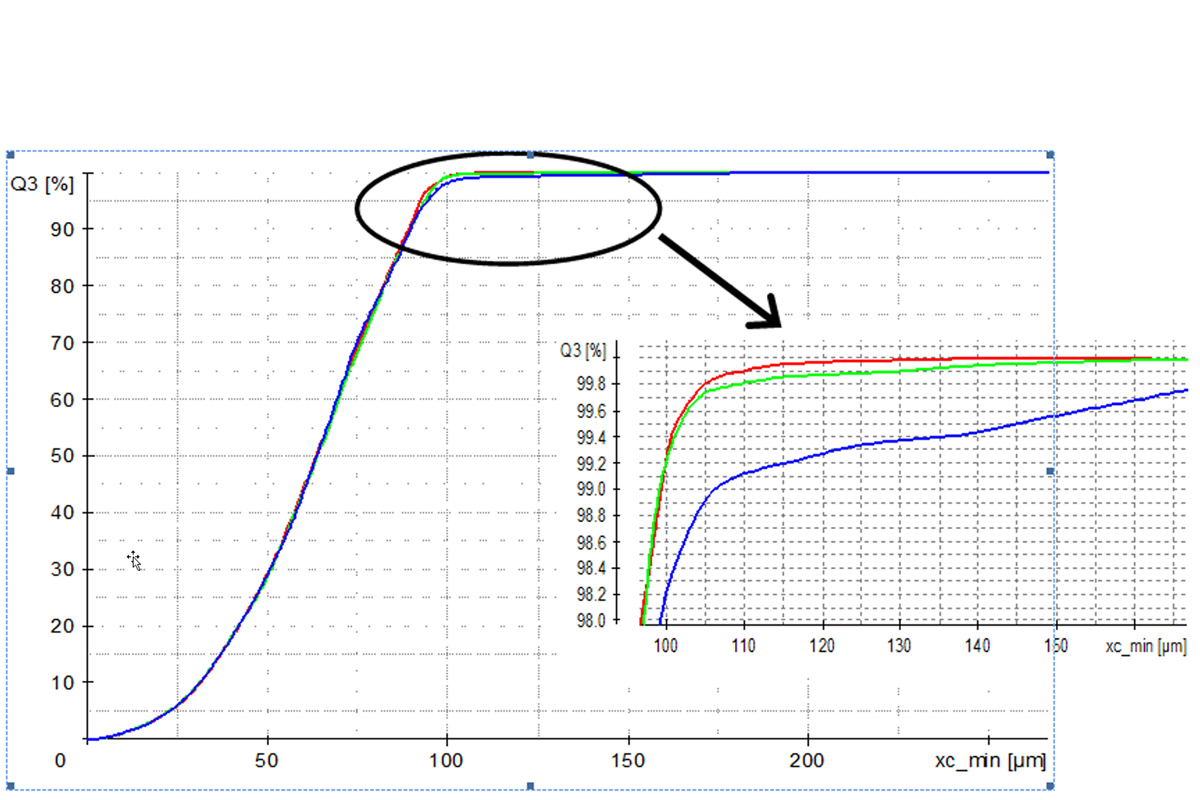
Figure 6 shows a silicate sample that was analyzed with the CAMSIZER X2 using the X-Fall module. First, the original sample was measured and the size distribution was found to range from 5 μm to 100 μm (red curve). Then, 0.1 % of oversized (> 100 μm) particles were added and the sample was analyzed again (green curve). Finally, the experiment was repeated with 1 % oversize added (blue curve).
This silicate is used as raw material for the coating of tiles and oversized particles will result in a rough and uneven surface of the finished tile. The CAMSIZER X2 reliably detects the correct amount of oversize. Note that below 100 μm, where all samples are identical, the reproducibility is excellent!
联系我们获取免费的建议

最终选择使用简单的筛分、激光衍射或者使动态图像技术 主要取决于测试的样品量、预算、人员、客户要求和采用的国际标准。 为何不联系Microtrac进行免费咨询,看看哪种解决方案能带来您所需要的结果和投资回报。