





10 Most Common Errors in Particle Analysis - And How to Avoid Them
Particle analysis is an integral part of the quality control of bulk materials and is routinely performed in numerous laboratories. The methods used have often been established for years and are hardly ever questioned. Nevertheless, the procedure should be critically reviewed from time to time because a whole series of sources of error can negatively influence the results of a particle analysis. This white paper is intended to provide food for thought to make methods for particle characterization more reliable and accurate.

21 CFR Part 11 Compliance Matrix for Microtrac Instruments
This document explains how Microtrac FLEX software has been designed to satisfy and comply with regulations in 21 CFR Part 11 for electronic records and electronic signatures.
A Conceptual, Non-Mathematical Explanation on the Use of Refractive Index in Laser Particle Size Measurement
An explanation of Mie scattering and how Microtrac laser diffraction analyzers evaluate scattering signal from small particles.
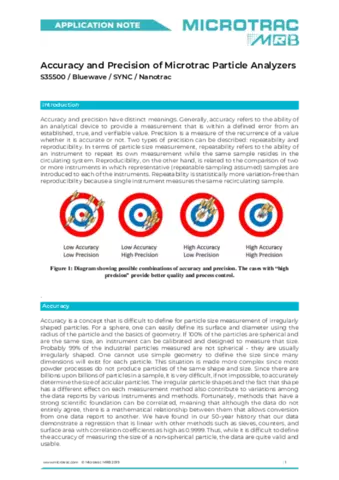
Accuracy and Precision of Microtrac Particle Analyzers
Accuracy and precision have distinct meanings. Generally, accuracy refers to the ability of an analytical device to provide a measurement that is within a defined error from an established, true, and verifiable value. Precision is a measure of the recurrence of a value whether it is accurate or not. Two types of precision can be described: repeatability and reproducibility. In terms of particle size measurement, repeatability refers to the ability of an instrument to repeat its own measurement while the same sample resides in the circulating system. Reproducibility, on the other hand, is related to the comparison of two or more instruments in which representative (repeatable sampling assumed) samples are introduced to each of the instruments. Repeatability is statistically more variation-free than reproducibility because a single instrument measures the same recirculating sample.

Beyond the surface, Cutting-edge adsorption approaches for porous material characterization by MICROTRAC
DLS Analysis of 2 Microliter Sample Volume with Nanotrac FLEX
The minumum required sample volume for DLS analysis with the Nanotrac Flex is only 2 µl. One other big advantage is that measurements can be performed at original high concentrations to avoid effects of dilution on the dispersion. This can be used for samples like therapeutic drugs, proteins, polymer solutions and others.
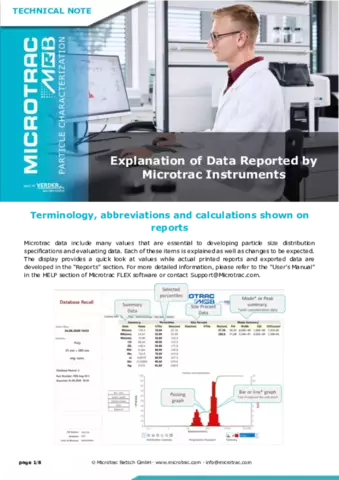
Explanation of Data Reported by Microtrac Instruments
A document explaining the various result data presented in the Microtrac Flex Software, e. g. percentiles, tabular data, mean values etc.
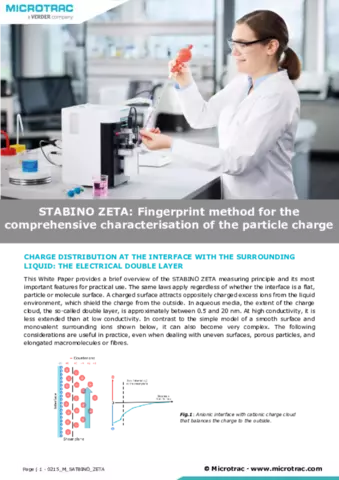
Fingerprint method for the comprehensive characterisation of the particle charge
A comprehensive description of the potential measurement with the Stabino Zeta.

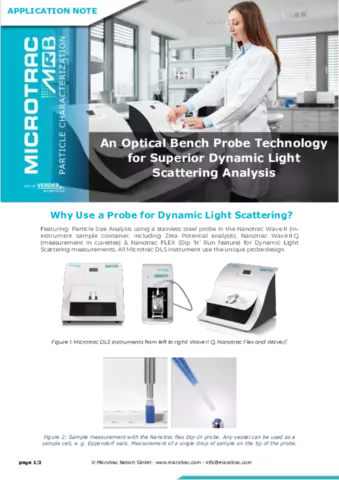
Nanotrac Probe-Technology for Superior DLS
Advantages of the unique Microtrac probe design for DLS.
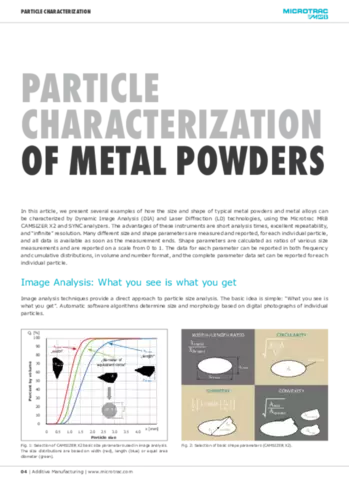
Particle Characterization of Metal Powders
In this article, we present several examples of how the size and shape of typical metal powders and metal alloys can be characterized by Dynamic Image Analysis (DIA) and Laser Diffraction (LD) technologies, using the Microtrac MRB CAMSIZER X2 and SYNC analyzers. We also take a closer look at the characterization of metal powder and its AM products with regard to density, surface and porosity.

Particle Tracking Reveals True Morphology
Dynamic image analysis is an established and proven method for the characterization of bulk solids. It detects and measures hundreds of thousands or even millions of particles within a few minutes. However, the images are snapshots, showing each particle in one of many possible perspectives, so the third dimension remains hidden. MICROTRAC’S CAMSIZER 3D now adds new perspectives to particle analysis, revealing the truth about the morphology of your sample.

Round Robin Test: Particle Analysis of Ceramic Powders by Laser Diffraction
The Microtrac laboratories in Haan (Germany), Osaka (Japan) and York (USA) successfully participated in an interlaboratory test conducted by BAM (German Federal Institute for Materials Research and Testing) in 2021. The focus of the test was "Measurement of the particle size distribution of ceramic powder by laser diffraction in accordance with ISO 13320”.
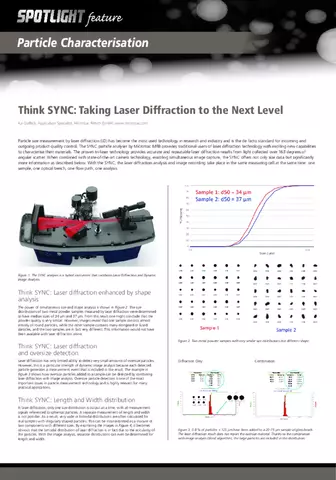
Think Sync: Taking Laser Diffraction to the Next Level
Particle size measurement by laser diffraction (LD) has become the most used technology in research and industry and is the de facto standard for incoming and outgoing product quality control. The SYNC particle analyser by Microtrac MRB provides traditional users of laser diffraction technology with exciting new capabilities to characterise their materials. The proven tri-laser technology provides accurate and repeatable laser diffraction results from light collected over 163 degrees of angular scatter. When combined with state-of-the-art camera technology, enabling simultaneous image capture, the SYNC offers not only size data but significantly more information as described below. With the SYNC, the laser diffraction analysis and image recording take place in the same measuring cell at the same time: one sample, one optical bench, one flow path, one analysis.

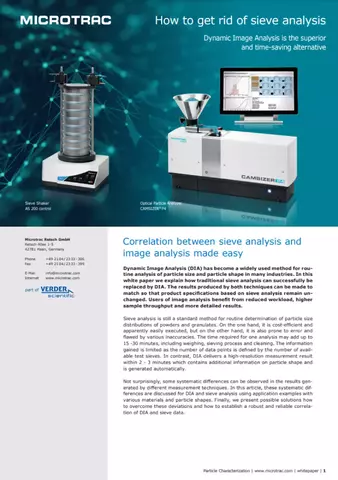
White Paper: Correlation between sieve analysis and image analysis made easy
Dynamic Image Analysis (DIA) has become a widely used method for routineanalysis of particle size and particle shape in many industries. In this white paper we explain how traditional sieve analysis can successfully be replaced by DIA. The results produced by both techniques can be made to match so that product specifications based on sieve analysis remain unchanged. Users of image analysis benefit from reduced workload, higher sample throughput and more detailed results.
Partikelgröße und Zetapotential von Tinten messen
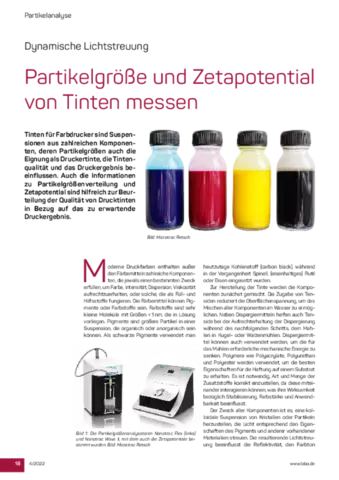
Tinten für Farbdrucker sind Suspensionen aus zahlreichen Komponenten, deren Partikelgrößen auch die Eignung als Druckertinte, die Tintenqualität und das Druckergebnis beeinflussen. Auch die Informationen zu Partikelgrößenverteilung und Zetapotential sind hilfreich zur Beurteilung der Qualität von Drucktinten in Bezug auf das zu erwartende Druckergebnis.
White Paper: Methodenvergleich Partikelanalyse
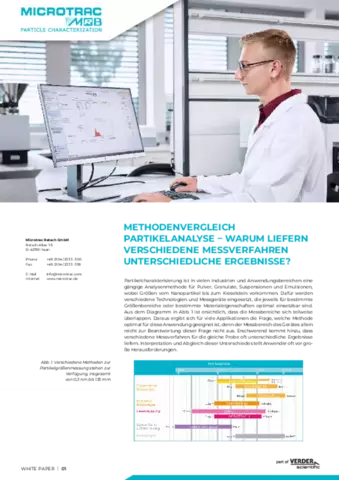
Warum liefern verschiedene Messverfahren unterschiedliche Ergebnisse? Partikelcharakterisierung ist in vielen Industrien und Anwendungsbereichen eine gängige Analysenmethode für Pulver, Granulate, Suspensionen und Emulsionen, wobei Größen vom Nanopartikel bis zum Kieselstein vorkommen. Dafür werden verschiedene Technologien und Messgeräte eingesetzt, die jeweils für bestimmte Größenbereiche oder bestimmte Materialeigenschaften optimal einsetzbar sind, wobei sich die Messbereiche teilweise überlappen. Daraus ergibt sich für viele Applikationen die Frage, welche Methode optimal für diese Anwendung geeignet ist, denn der Messbereich des Gerätes allein reicht zur Beantwortung dieser Frage nicht aus. Erschwerend kommt hinzu, dass verschiedene Messverfahren für die gleiche Probe oft unterschiedliche Ergebnisse liefern. Interpretation und Abgleich dieser Unterschiede stellt Anwender oft vor große Herausforderungen. In diesem Whitepaper sollen die gängigen Methoden der Partikelanalyse zunächst vorgestellt und dann miteinander verglichen werden.