




Building materials are required for a wide range of construction work including carpentry, roofing, structural reinforcement, insulation, and plumbing. The particle size and particle shape of the raw materials influence quality and performance of the end product, and therefore require quality control by particle characterization. Microtrac analyzers are successfully used to determine the size and shape of various building materials.
Building materials range from naturally occurring substances such as rock, clay, sand, and wood to synthetic polymers and multiple combinations of both (composites). Concrete or mortar are for example mixtures of cement and aggregates like sand or gravel.
Why are particle properties so important for building materials?
- Powder flow: a wide distribution or too many fines reduce flowability
- Segregation: a wide distribution will lead to size segregation
- Suspension rheology: fines or irregularly shaped particles increase viscosity
Problematic effects due to oversized particles
- Poor quality of the final product (grains sticking out of the plaster, rough surfaces of tiles, inhomogeneous materials may break)
- Changes in the “look and feel” of the final product
- Changes in the flow behavior and other process parameters of the final product
- Blockage of production sieves
- Removal of material from the production process, and recycling (additional costs and effort)
Problematic effects due to undersized particles
- Change of the “look and feel” of the final product
- Dust (pollution) in the work place
- Filter blockage
- Changes in the flow behaviour and other process parameters of the final product
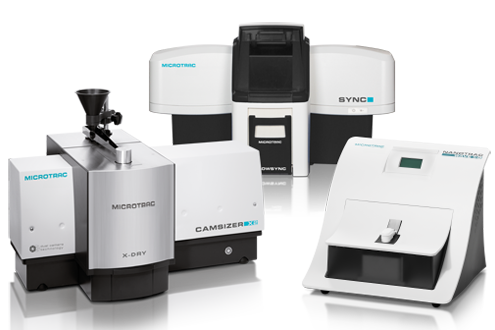
Microtrac propose des produits pour toutes les technologies d'analyse de la taille des particules.
Solution Analyse de la Taille des Particules par SMLS avec TURBISCAN
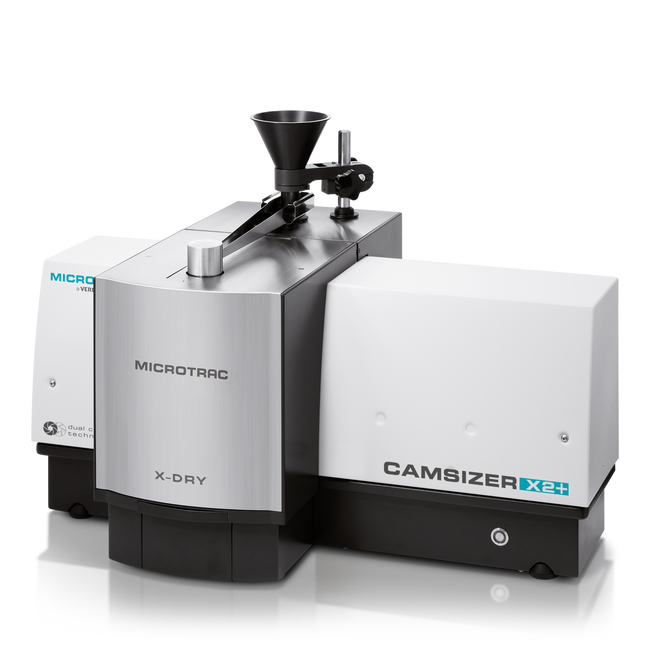
Temps de mesure plus court. Meilleure résolution optique. Plus d'images par seconde. Le CAMSIZER X2+ est l'un des analyseurs de taille et de forme de particules les plus puissants et les plus polyvalents, avec une large plage de mesure qui combine une technologie de caméra de pointe et des options de dispersion flexibles. Basé sur le principe de l'analyse d'image dynamique (ISO 13322-2), le CAMSIZER X2+ fournit des informations précises sur la taille et la forme des particules de poudres, granulés et suspensions dans une plage de mesure allant de 0,9 μm à 8 mm. Le CAMSIZER X2+ produit un flux de particules caractérisé par un système optique à haute résolution. Une source lumineuse stroboscopique LED ultra-lumineuse et deux caméras numériques haute résolution permettent d'atteindre une fréquence d'images de plus de 420 images par seconde, qui sont évaluées en temps réel par un logiciel puissant. Ainsi, le CAMSIZER X2+ capture les images de centaines de milliers à plusieurs millions de particules avec une précision maximale en seulement 1 à 3 minutes. Le CAMSIZER X2+ fournit un large éventail d'informations sur les particules, ce qui permet une caractérisation complète et fiable du matériau échantillonné. Il convient aussi bien à la R&D qu'aux tâches de routine dans le domaine du contrôle qualité.
Exemple 1 Describing static light scattering patterns
In most cases the particle size distribution of sand used in building materials is analyzed by sieve analysis. Microtrac's CAMSIZER series can replace this time-consuming and error-prone technique with a quicker, more reliable method that provides a higher resolution of particle size results as well as additional particle shape information.
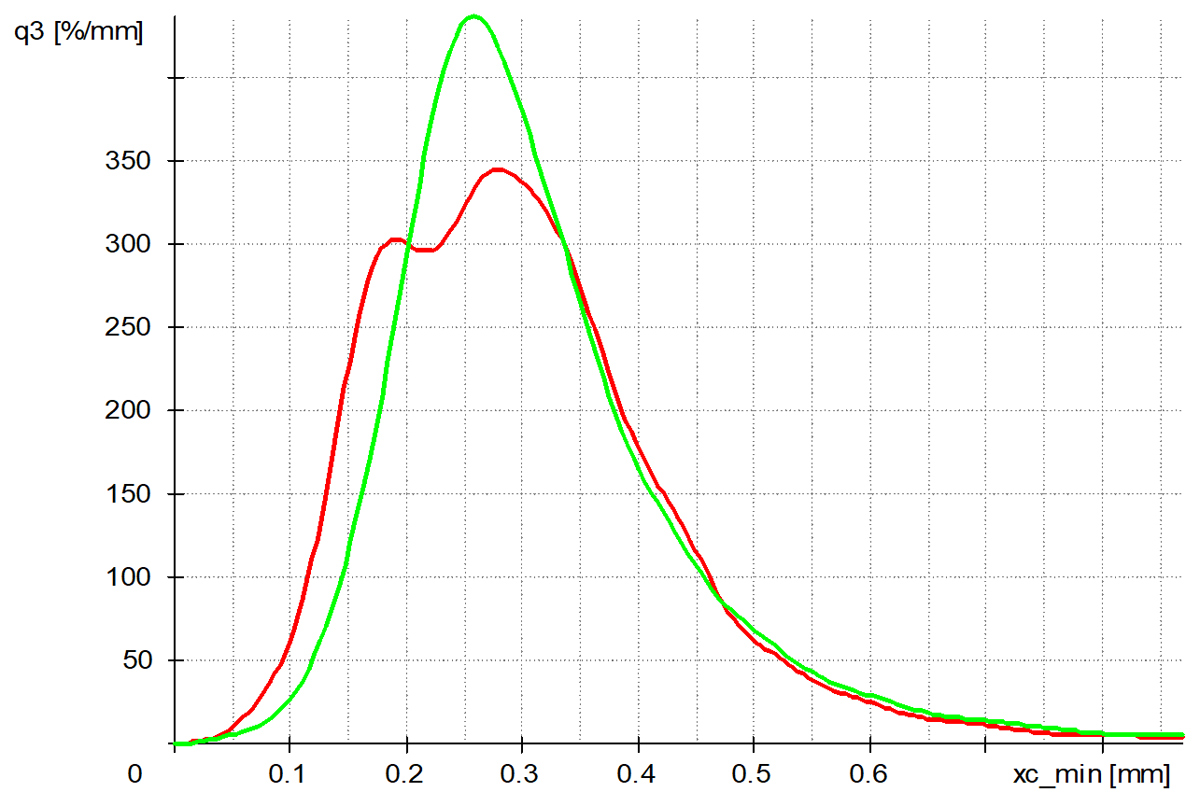
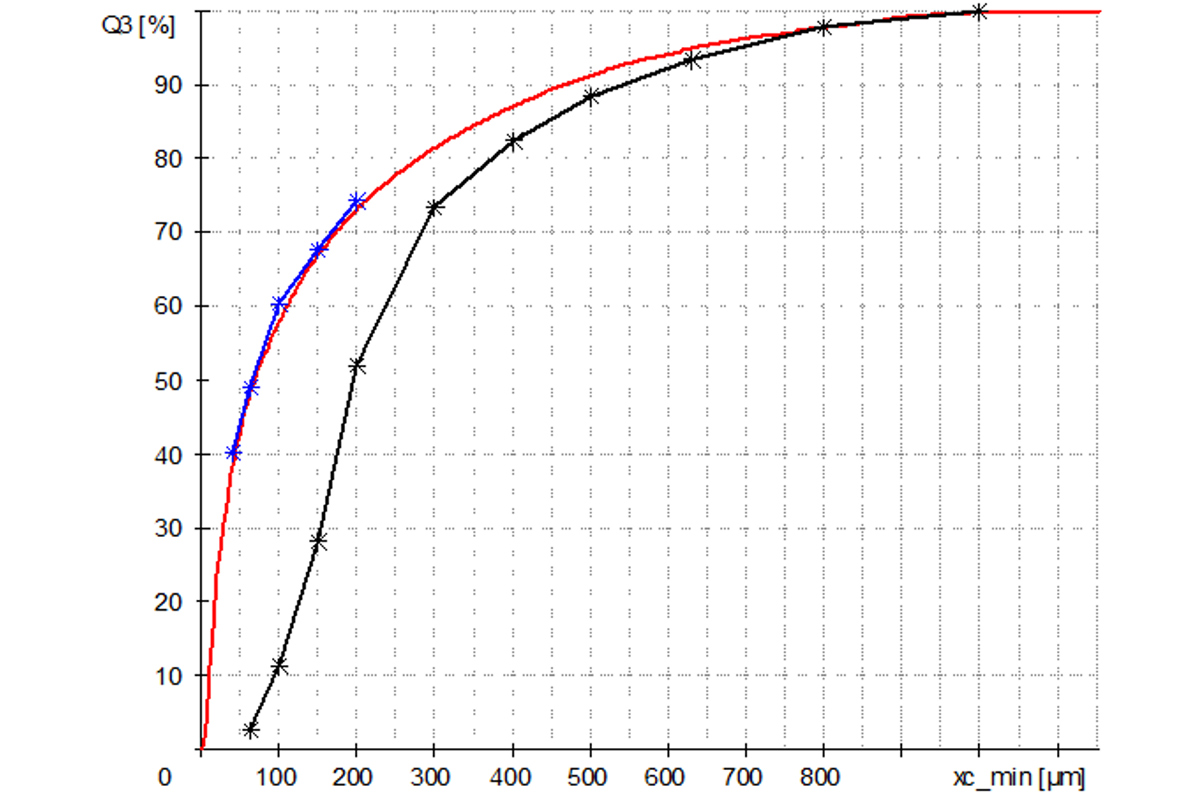
Deux types de sable prélevés à différents endroits, mesurés avec le CAMSIZER X2. Ce sable est utilisé comme couche dans les tuyaux en plastique renforcé de verre pour en augmenter la rigidité. Le paramètre de taille indiqué est xc min (= largeur des particules). La courbe rouge est légèrement bimodale. Le sable avec une large distribution de taille peut être plus étroitement tassé au cœur du tuyau, ce qui confère au produit fini une plus grande stabilité.
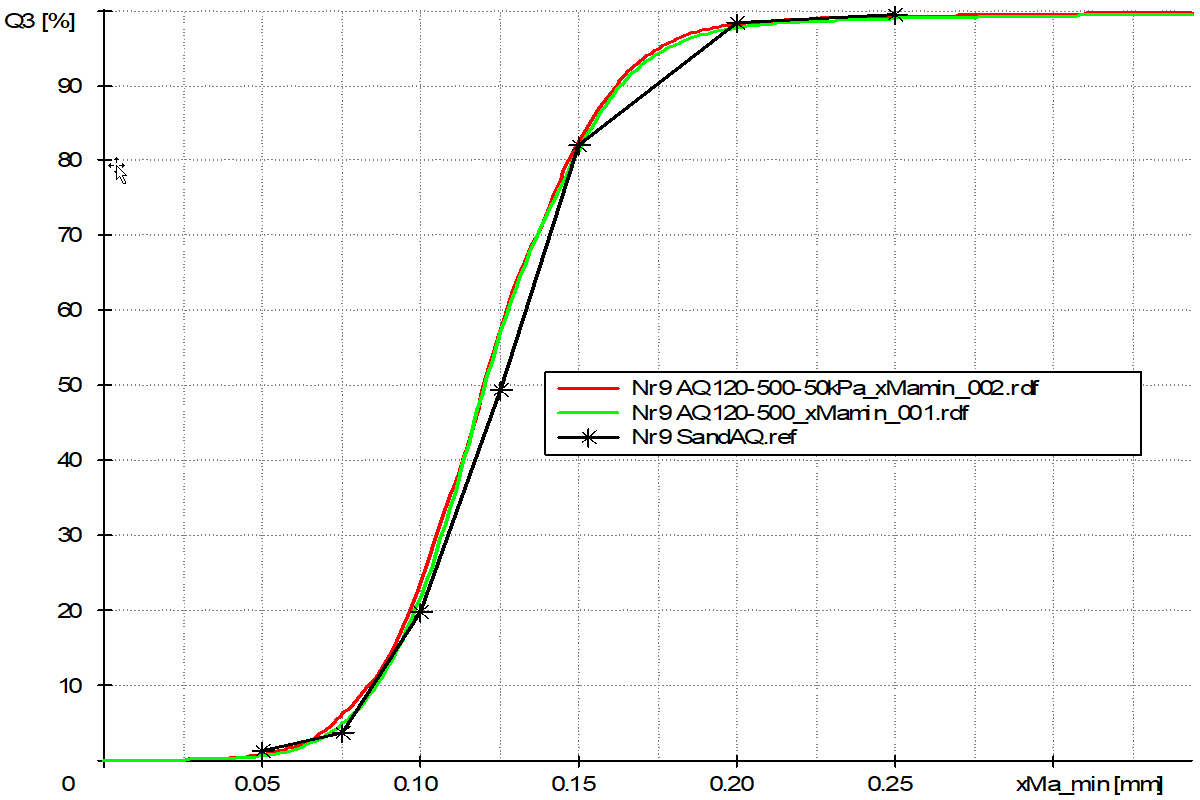
One sand sample that was measured by sieving (black) and by the CAMSIZER X2 using two different dispersion modules: the X-Fall module (green) and the X-Jet module (red). The results compare extremely well, proving that CAMSIZER X2 can match existing sieve analysis results. Hence, product specifications based on sieve analysis can remain unchanged when transitioning to a CAMSIZER system.
Exemple 2 Particle size & shape analysis of limestone
Limestone (calcium carbonate) is a raw material used in many products.
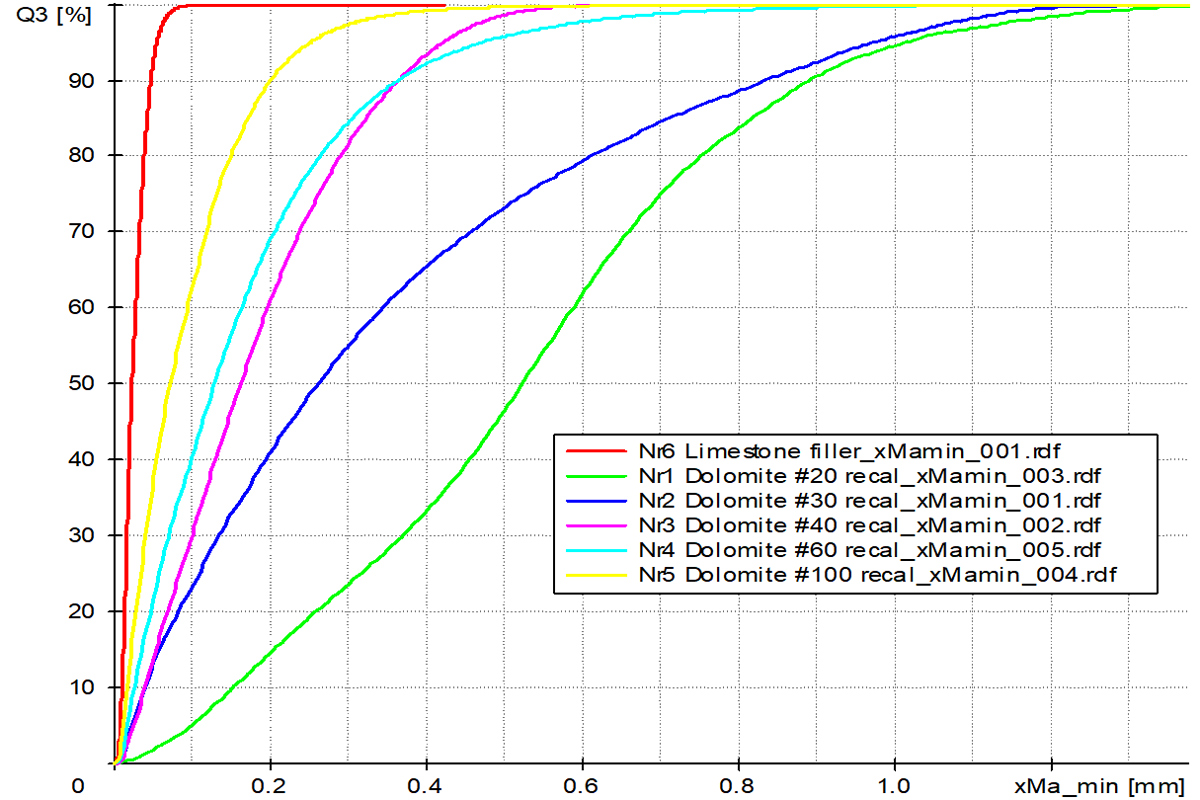
The particle size distribution as measured with the CAMSIZER X2 for a range of limestone grades.
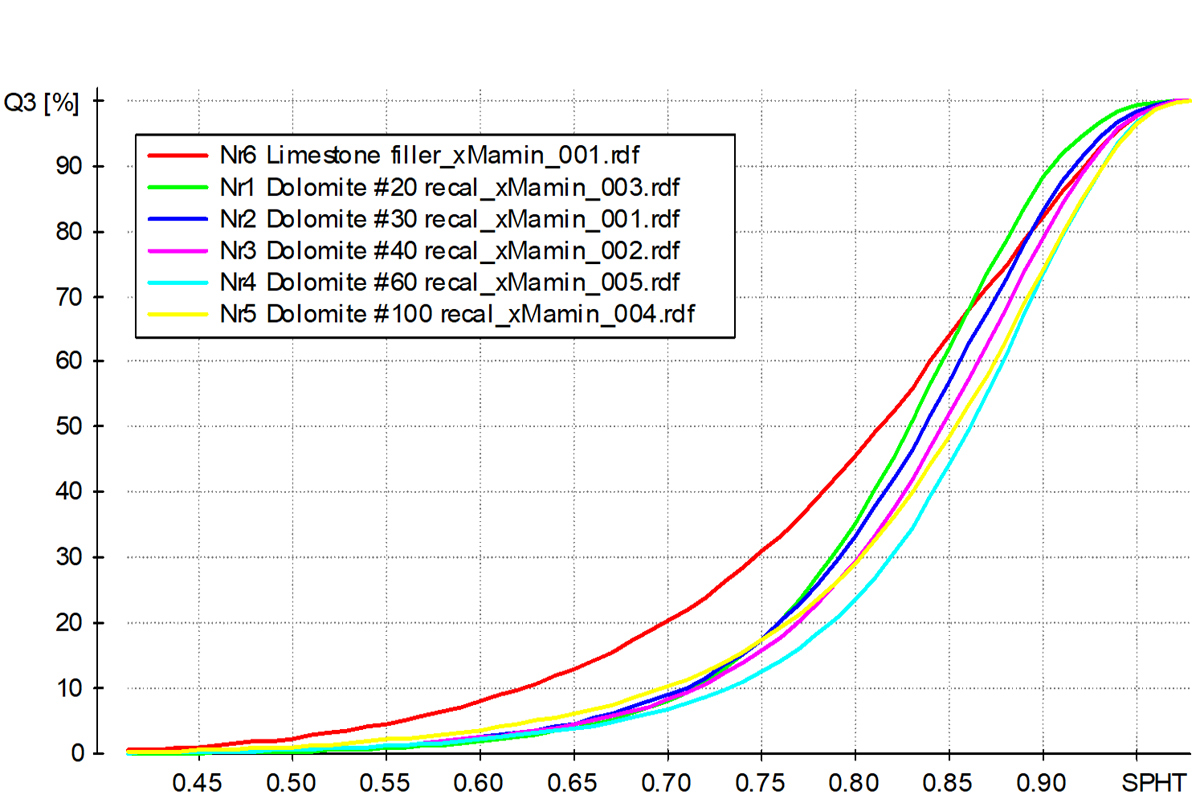
The particle shape distribution results for the same collection of limestone samples. The reported shape parameter is sphericity, defined as: sphericity = 4 p A/ P2 where "A = Area of the particle projection" and "P = Perimeter length of the particle projection". The least round sample is Nr 6 (red), while the most round sample is Nr 4 (light blue).
Exemple 3 Effective dispersion of plaster samples
The characteristic light scattering patterns which are formed when a laser interacts with particles are caused by diffraction, refraction, reflection, and absorption (as shown on the figure).
For large particles, diffraction, which occurs at the contour of particles, is the dominant mechanism. This is sufficiently described by the so-called Fraunhofer theory. "Large particles" in this context means "significantly larger than the wavelength of light".
For the description and evaluation of scattered light patterns of smaller particles, the optical properties, essentially the refractive index, must be considered. This is described by the Mie theory, which, however, also includes diffraction and therefore allows a comprehensive evaluation of light scattering phenomena.
Literature values are available for the refractive indices of almost all solids, so Mie theory can be applied very reliably for static light scattering. Static light scattering is often referred to as laser diffraction or laser diffractometry, even independent of the size of the particles considered and the phenomena that occur.
Exemple 4 Detection of oversize in tile coatings
Save and reliable detection of oversized particles are among the most important objectives of particle size analyis. For this purpose, Dynamic Image Analysis with the CAMSIZER X2 is the most powerful technique with unmatched accuracy.
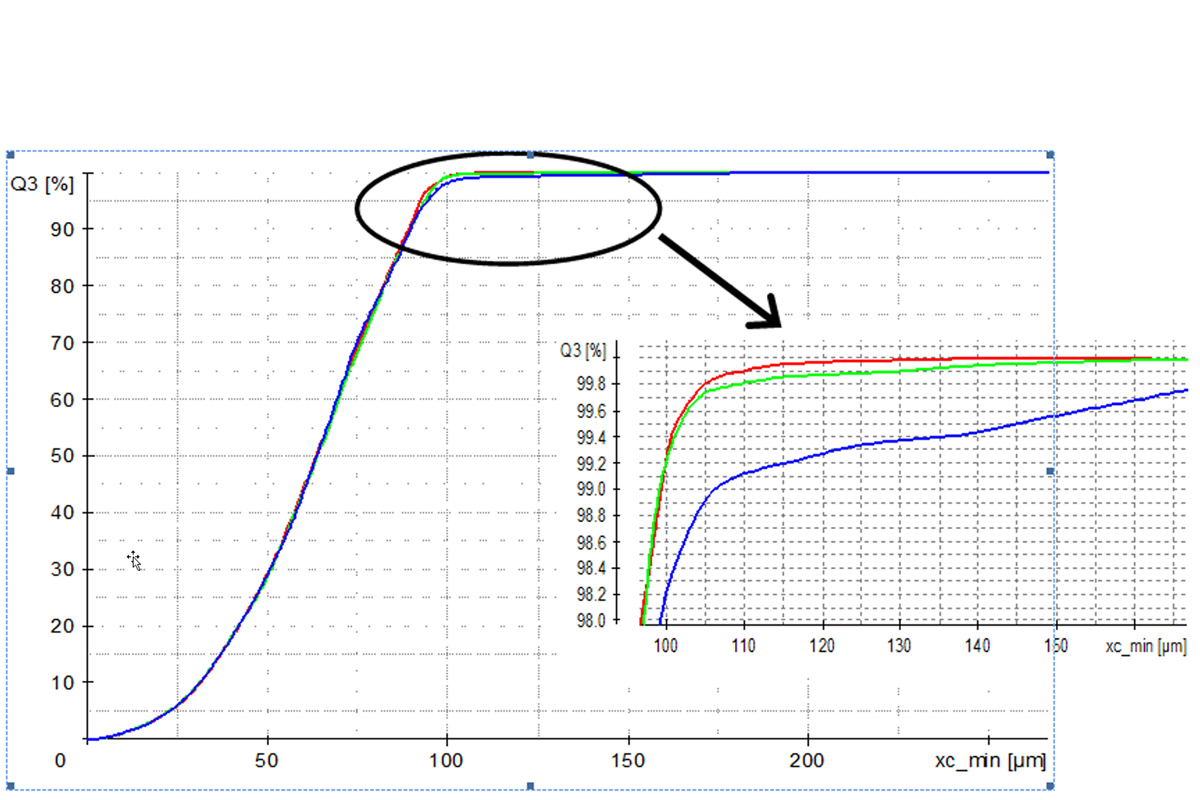
Figure 6 shows a silicate sample that was analyzed with the CAMSIZER X2 using the X-Fall module. First, the original sample was measured and the size distribution was found to range from 5 μm to 100 μm (red curve). Then, 0.1 % of oversized (> 100 μm) particles were added and the sample was analyzed again (green curve). Finally, the experiment was repeated with 1 % oversize added (blue curve).
This silicate is used as raw material for the coating of tiles and oversized particles will result in a rough and uneven surface of the finished tile. The CAMSIZER X2 reliably detects the correct amount of oversize. Note that below 100 μm, where all samples are identical, the reproducibility is excellent!
Contactez nous pour un devis gratuit

En fin de compte, le choix d'utiliser une solution de tamisage simple ou d'investir dans la diffraction laser ou l'analyse dynamique d'images dépendra du volume d'essais, du budget et du personnel disponibles, ainsi que des normes internationales spécifiques ou des exigences des clients auxquelles vous devez faire face.
Pourquoi ne pas contacter Microtrac pour une consultation gratuite afin de déterminer quelle solution vous apportera les résultats et le retour sur investissement dont vous avez besoin ?