




Building materials are required for a wide range of construction work including carpentry, roofing, structural reinforcement, insulation, and plumbing. The particle size and particle shape of the raw materials influence quality and performance of the end product, and therefore require quality control by particle characterization. Microtrac analyzers are successfully used to determine the size and shape of various building materials.
Building materials range from naturally occurring substances such as rock, clay, sand, and wood to synthetic polymers and multiple combinations of both (composites). Concrete or mortar are for example mixtures of cement and aggregates like sand or gravel.
Why are particle properties so important for building materials?
The particle size and particle shape of raw materials are important for many reasons. The particle size distribution has various effects on the processing of building materials, for example:
- Powder flow: a wide distribution or too many fines reduce flowability
- Segregation: a wide distribution will lead to size segregation
- Suspension rheology: fines or irregularly shaped particles increase viscosity
Problematic effects due to oversized particles
- Poor quality of the final product (grains sticking out of the plaster, rough surfaces of tiles, inhomogeneous materials may break)
- Changes in the “look and feel” of the final product
- Changes in the flow behavior and other process parameters of the final product
- Blockage of production sieves
- Removal of material from the production process, and recycling (additional costs and effort)
Problematic effects due to undersized particles
- Change of the “look and feel” of the final product
- Dust (pollution) in the work place
- Filter blockage
- Changes in the flow behaviour and other process parameters of the final product
Wir bieten Analysengeräte für sämtliche Partikelgrößenanalysetechniken.
Lösung Partikelgrößenanalyse mit SMLS und TURBISCAN
Kürzere Messzeit. Höhere optische Auflösung. Mehr Bilder pro Sekunde.
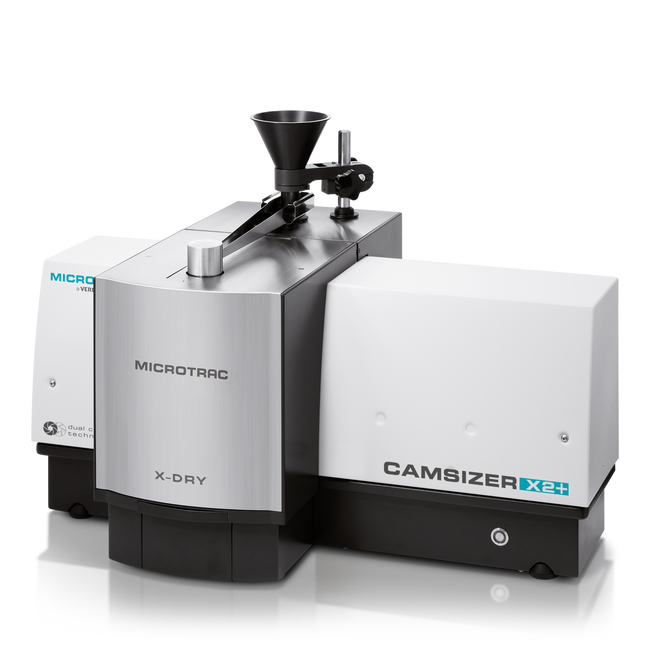
Der CAMSIZER X2+ ist eines der leistungsstärksten und außerordentlich vielseitigen Geräte zur Partikelgrößen- und -formanalyse mit großem Messbereich. Er verbindet modernste Kameratechnik mit flexiblen Dispergieroptionen. Auf Basis der dynamischen Bildanalyse nach ISO 13322-2 liefert der CAMSIZER X2+ präzise Informationen zur Partikelgröße und -form von Pulvern, Granulaten und Suspensionen in einem Messbereich von 0,9 μm bis 8 mm.
Der CAMSIZER X2+ erzeugt einen Partikelstrom, der von einem optischen System mit hoher Auflösung erfasst wird. Sehr helle LED-Stroboskop-Lichtquellen und zwei hochauflösende Digitalkameras ermöglichen eine Bildrate von mehr als 420 Aufnahmen pro Sekunde, die in Echtzeit von einer leistungsfähigen Software ausgewertet werden. So erfasst der CAMSIZER X2+ innerhalb von nur 1 bis 3 Minuten die Bilder von Hunderttausenden bis hin zu mehreren Millionen Partikeln mit höchster Genauigkeit.
Der CAMSIZER X2+ liefert eine Vielzahl von Partikelkennwerten und ermöglicht damit eine umfassende und verlässliche Charakterisierung des Probenmaterials. Er ist sowohl für den Einsatz in Forschung und Entwicklung als auch für Routineaufgaben in der Qualitätskontrolle geeignet.
Beispiel 1 Statische Lichtstreuung: Streulichtmuster und Partikelgröße
In most cases the particle size distribution of sand used in building materials is analyzed by sieve analysis. Microtrac's CAMSIZER series can replace this time-consuming and error-prone technique with a quicker, more reliable method that provides a higher resolution of particle size results as well as additional particle shape information.
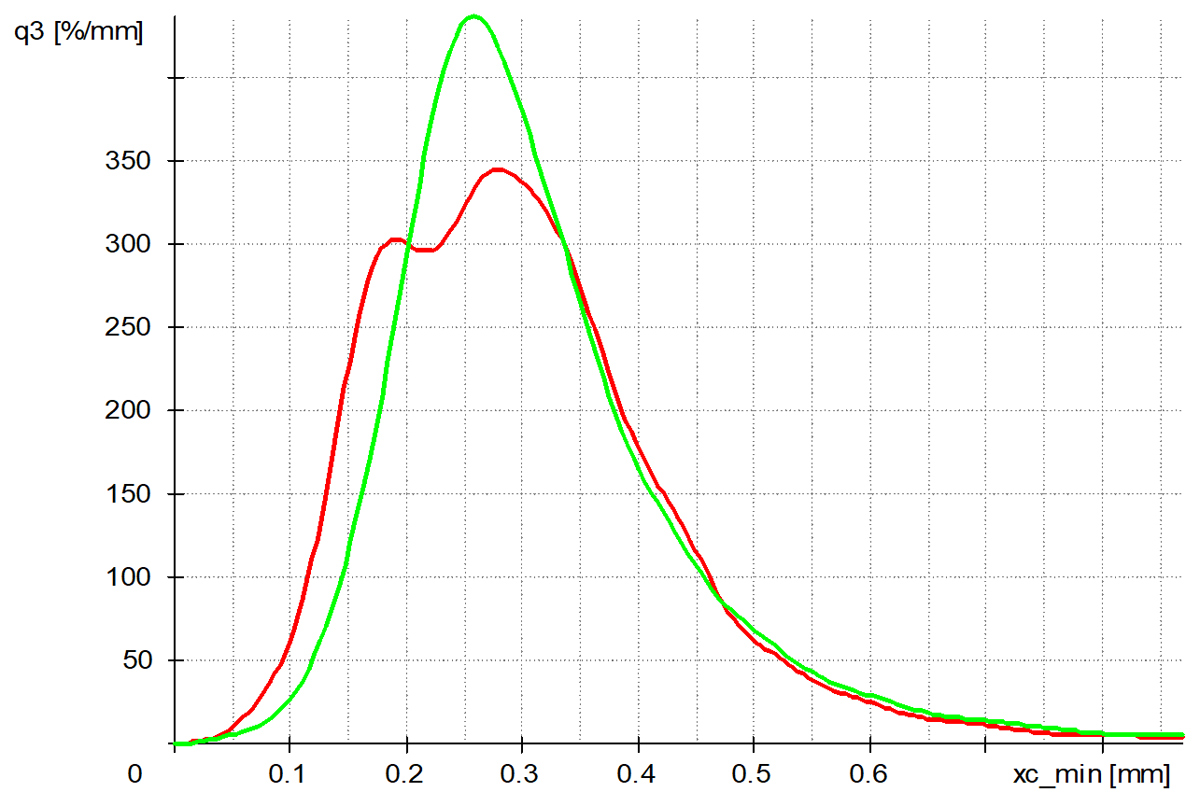
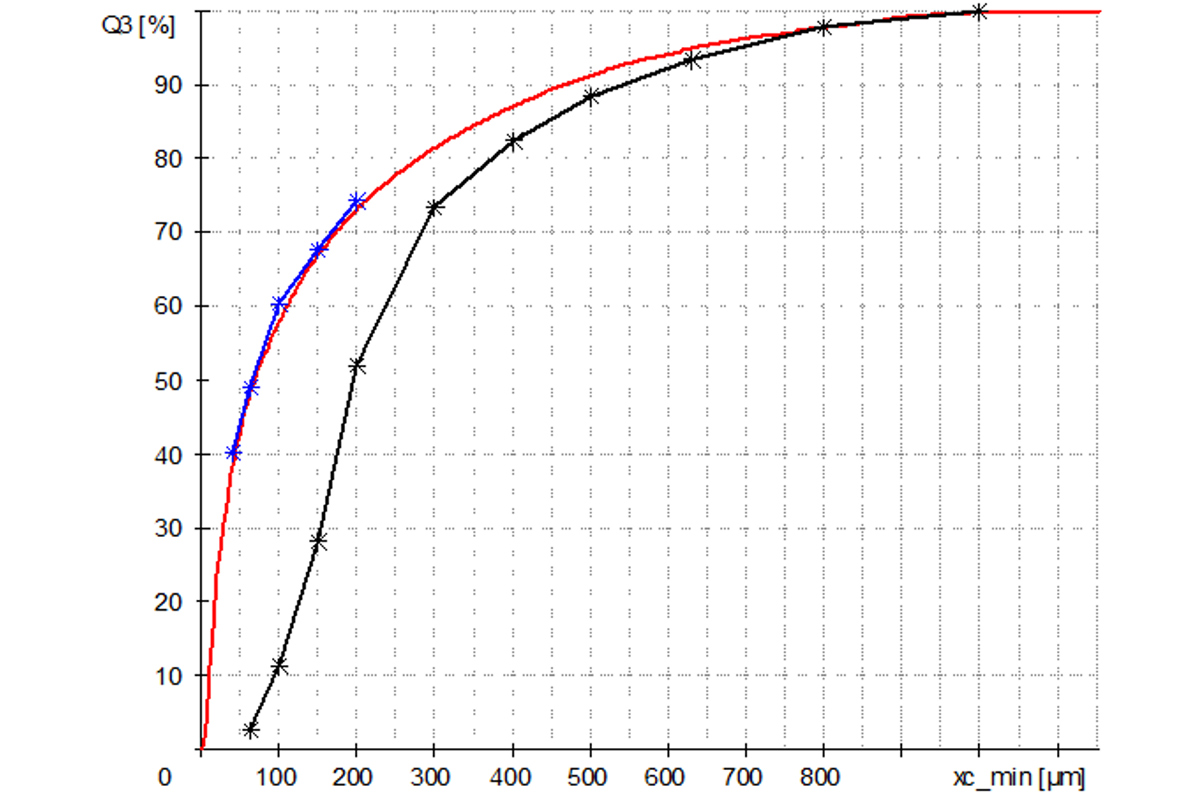
Zwei Sandarten aus unterschiedlichen Standorten, gemessen mit dem CAMSIZER X2. Dieser Sand wird als Schicht in glasfaserverstärkten Kunststoffrohren verwendet, um die Steifigkeit zu erhöhen. Der berichtete Größenparameter ist xc min (=Partikelbreite). Die rote Kurve ist leicht bimodal. Sand mit einer breiten Größenverteilung kann im Kern des Rohrs dichter gepackt werden, was dem Endprodukt eine höhere Stabilität verleiht.
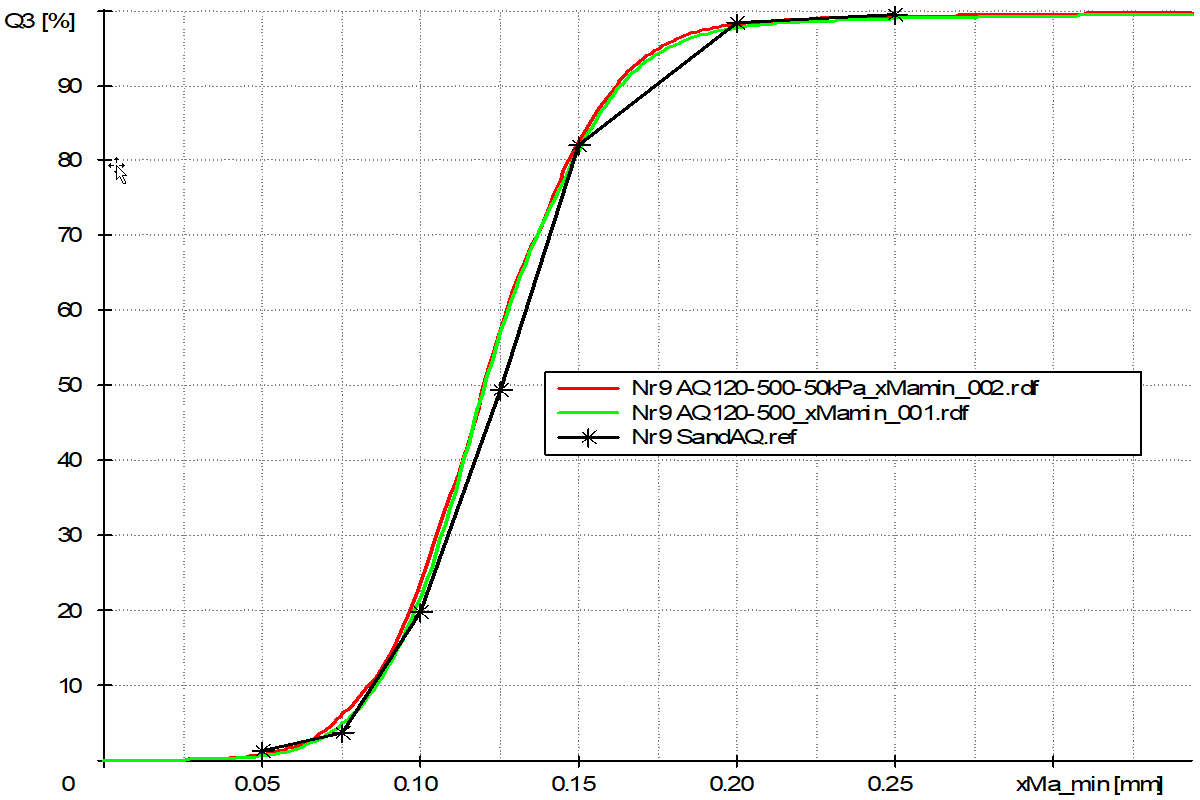
One sand sample that was measured by sieving (black) and by the CAMSIZER X2 using two different dispersion modules: the X-Fall module (green) and the X-Jet module (red). The results compare extremely well, proving that CAMSIZER X2 can match existing sieve analysis results. Hence, product specifications based on sieve analysis can remain unchanged when transitioning to a CAMSIZER system.
Beispiel 2 Particle size & shape analysis of limestone
Limestone (calcium carbonate) is a raw material used in many products.
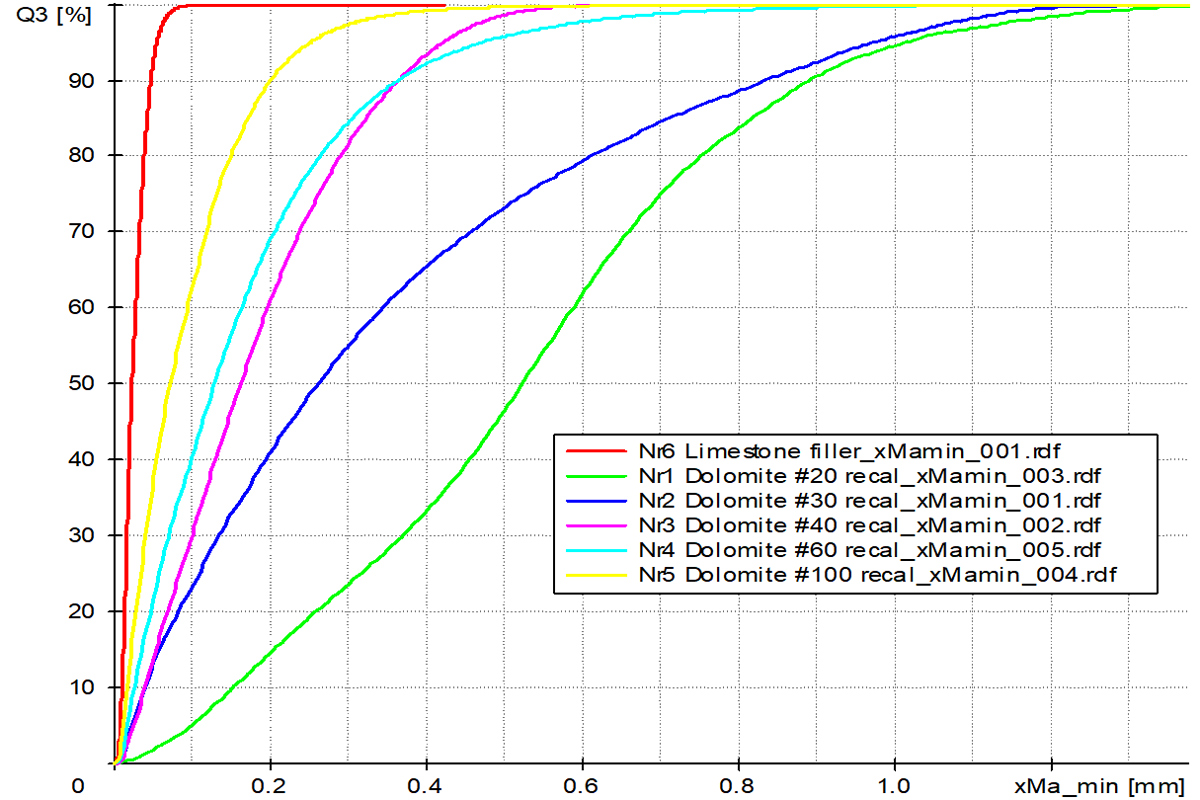
The particle size distribution as measured with the CAMSIZER X2 for a range of limestone grades.
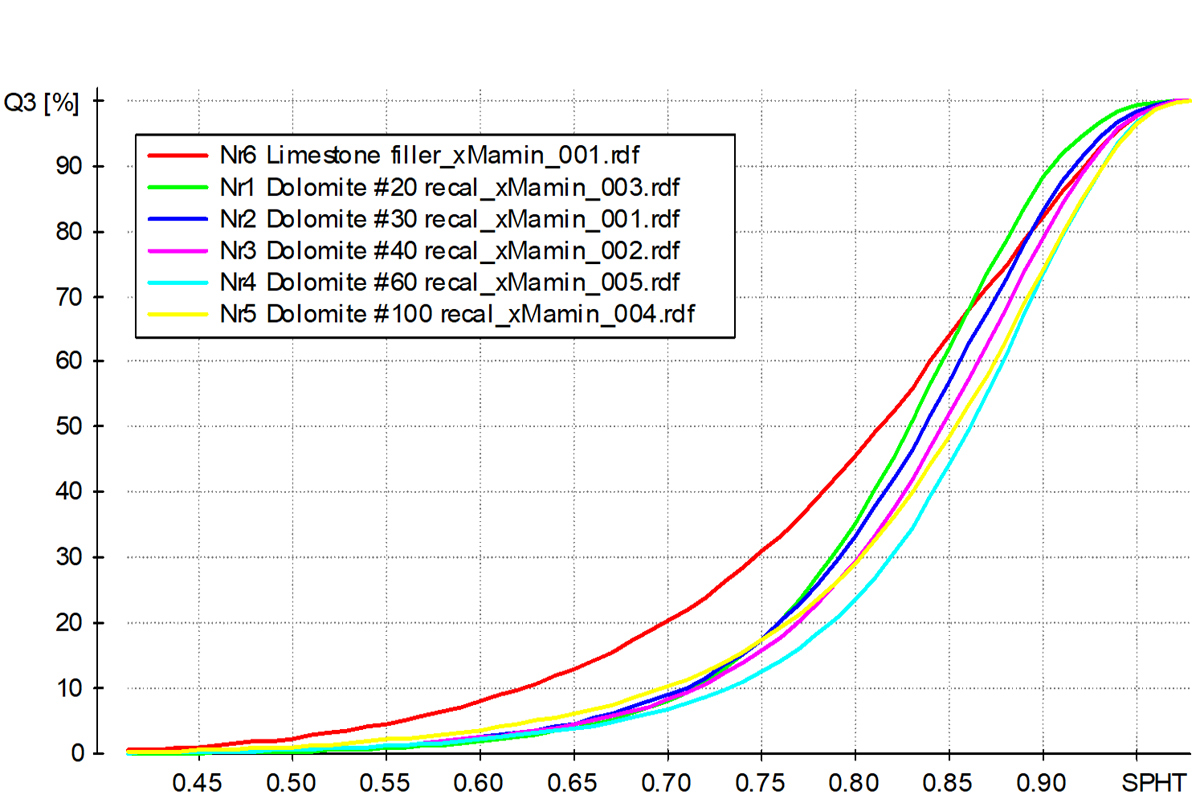
The particle shape distribution results for the same collection of limestone samples. The reported shape parameter is sphericity, defined as: sphericity = 4 p A/ P2 where "A = Area of the particle projection" and "P = Perimeter length of the particle projection". The least round sample is Nr 6 (red), while the most round sample is Nr 4 (light blue).
Beispiel 3 Effective dispersion of plaster samples
Die charakteristischen Streulichtmuster entstehen bei der Wechselwirkung von Laserlicht mit Partikeln durch Beugung, Brechung, Reflexion und Absorption (siehe Abbildung).
Für große Partikel ist die Beugung entscheidend, die am Rand des Partikels geschieht. Diese ist durch die sogenannte Fraunhofer-Theorie ausreichend beschrieben. „Große Partikel“ bedeutet in diesem Zusammenhang „deutlich größer als die Wellenlänge des Lichtes“.
Für die Beschreibung und Auswertung von Streulichtmustern kleinerer Partikel müssen die optischen Eigenschaften, d. h. im Wesentlichen der Brechungsindex, beachtet werden. Dies wird umfassend durch die Mie-Theorie beschrieben, die allerdings auch Beugung beinhaltet und daher eine umfassende Auswertung von Streuphänomenen ermöglicht.
Für die Brechungsindizes sind von nahezu allen Feststoffen Literaturwerte vorhanden, sodass die Mie-Theorie sehr zuverlässig für die statische Lichtstreuung eingesetzt werden kann. Die statische Lichtstreuung wird oft, auch unabhängig von der Größe der betrachteten Partikel und der auftretenden Phänomene, als Laserbeugung oder Laser-Diffraktometrie bezeichnet.
Beispiel 4 Detection of oversize in tile coatings
Save and reliable detection of oversized particles are among the most important objectives of particle size analyis. For this purpose, Dynamic Image Analysis with the CAMSIZER X2 is the most powerful technique with unmatched accuracy.
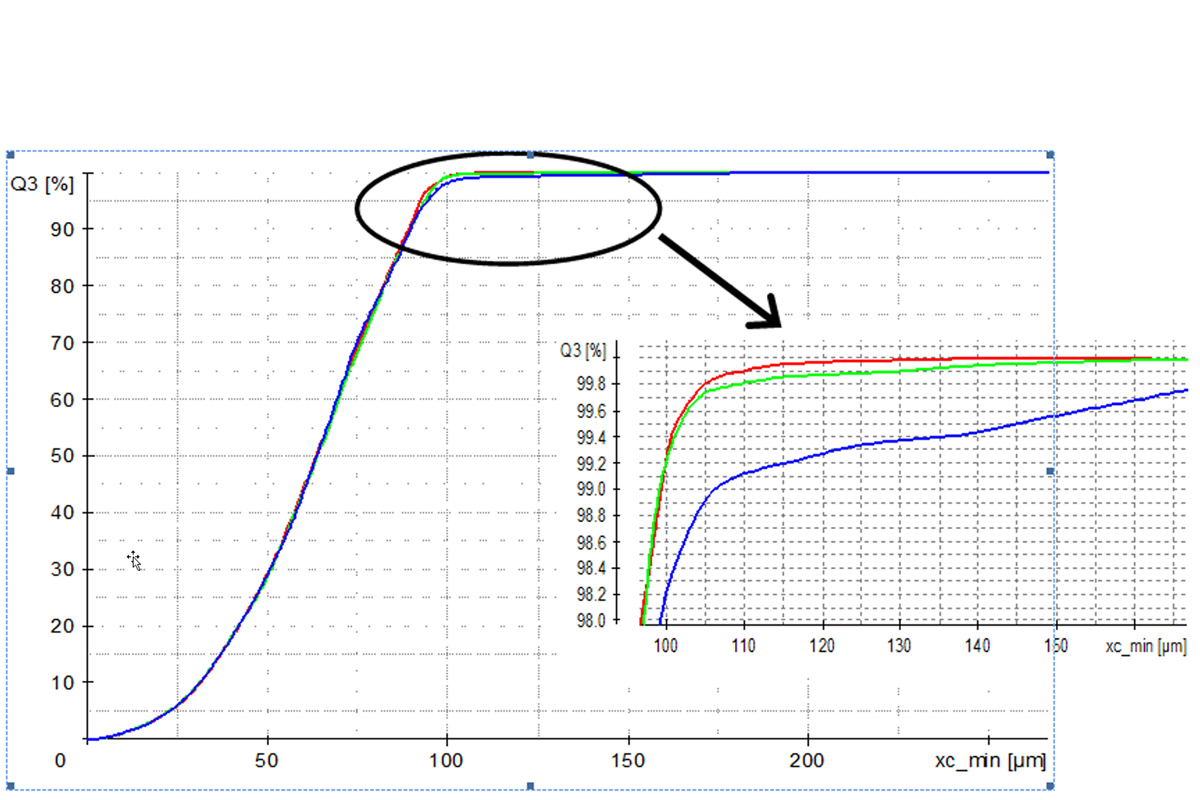
Figure 6 shows a silicate sample that was analyzed with the CAMSIZER X2 using the X-Fall module. First, the original sample was measured and the size distribution was found to range from 5 μm to 100 μm (red curve). Then, 0.1 % of oversized (> 100 μm) particles were added and the sample was analyzed again (green curve). Finally, the experiment was repeated with 1 % oversize added (blue curve).
This silicate is used as raw material for the coating of tiles and oversized particles will result in a rough and uneven surface of the finished tile. The CAMSIZER X2 reliably detects the correct amount of oversize. Note that below 100 μm, where all samples are identical, the reproducibility is excellent!
Kontaktieren Sie uns für eine kostenlose Beratung

Letztendlich hängt die Entscheidung, welche Methode der Partikelgrößenanalyse für Sie am besten geeignet ist von Prüfvolumen, verfügbarem Budget und Personal sowie den spezifischen internationalen Normen oder Kundenanforderungen ab, die es zu erfüllen gilt.
Gerne unterstützen wir Sie mit einer kostenlosen Beratung, um die optimale Lösung für Ihre spezifischen Anforderungen zu finden.